

In the high-stakes arena of digital PR and tier-one editorial link building, cold email outreach remains the definitive bridge connecting your research to influential editors, journalists, and webmasters. Yet, over 90% of outreach campaigns fail miserably—averaging sub-10% open rates and dismal 1% conversion ratios. Achieving consistent 40%+ open rates and double-digit link placements requires shifting from generic mass mailings to behavioral email psychology, cognitive pattern disruption, and strict deliverability engineering.
The Cognitive Psychology of the Inbox: Gatekeepers and Attention Scarcity
Modern editors and journalists receive upwards of 150 to 300 unsolicited pitches every single day. Within this overwhelmed environment, an inbox recipient operates in a state of rapid triage. They do not read cold emails; they scan for immediate reasons to archive, report as spam, or delete.
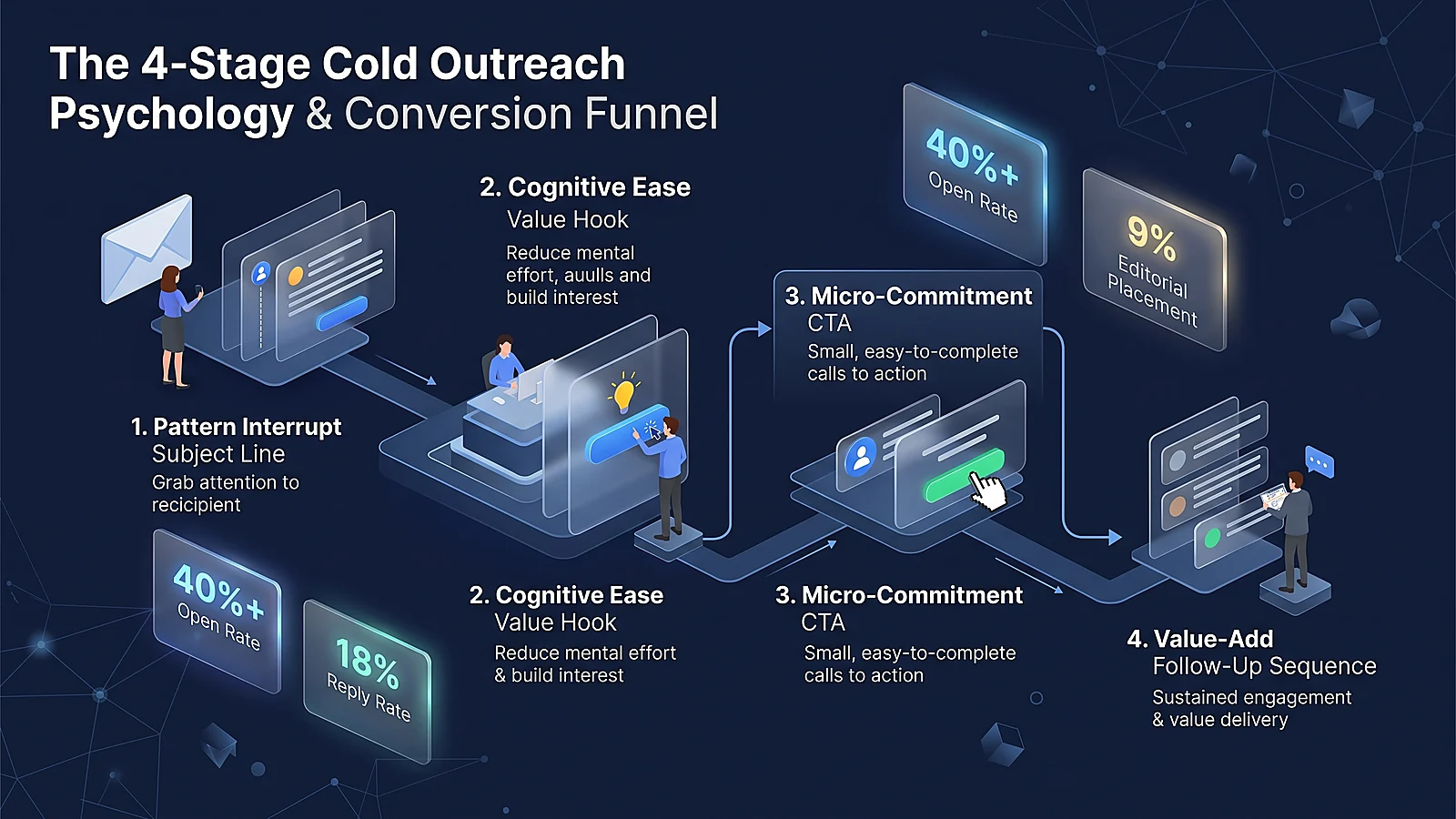
To navigate this psychological gatekeeper, outreach specialists must master four behavioral cognitive triggers:
- Pattern Interrupt: Standard automated outreach pitches share identical, tired formulations (e.g., "Quick question regarding your blog", "Collaboration opportunity"). Breaking linguistic syntax patterns jolts the recipient's subconscious out of auto-deletion mode.
- The Scarcity & Exclusivity Principle: High-tier journalists thrive on breaking scoops and proprietary data. Positioning insights as an exclusive pre-release or proprietary survey activates the fear of missing out (FOMO).
- WIIFM (What's In It For Me?): Editorial link building is not about asking for a favor; it is an economic exchange of value. You must solve an immediate editorial problem for the journalist—providing authoritative data, quotable expert analysis, or filling an information void in their recent story.
- Social Proof and Status Anchoring: Referencing shared academic research, mutual industry colleagues, or authoritative tier-one citations establishes immediate domain credibility, dissolving skepticism within seconds.
The Anatomy of a 40%+ Open Rate Subject Line
The subject line is the singular factor determining whether your pitch earns an evaluation or languishes in the trash. In mobile mail clients, you have approximately 30 to 45 characters before text truncation occurs.
1. High-Converting Subject Line Archetypes
- The Ultra-Specific Data Hook:
[Dataset]: 68% of SaaS Sites Suffer Crawl Waste(Immediate intrigue, no promotional fluff). - The Editorial Correction / Complement:
Question on your [Recent Article Topic] piece(Appeals to editorial pride and factual accuracy). - The Pre-Release Scoop:
Exclusive data on [Industry Trend] before Thursday(Creates time-sensitive urgency). - The Hyper-Personalized Observation:
Loved your quote on [Specific Point] in [Publication](Proves human research and validates author authority).
2. The Three Deadly Sins of Cold Subject Lines
- All-Caps and Excessive Punctuation: Words like
URGENT,FREE, or multiple exclamation points trigger spam filters and immediately signal low-quality mass marketing. - Misleading "Re:" or "Fwd:" Prefixes: Artificially fabricating an ongoing email chain creates severe cognitive betrayal once the recipient realizes they have been deceived, driving immediate spam complaints.
- Vague Clickbait: Subject lines that obscure the topic (e.g., "You won't believe this") irritate busy professionals and degrade long-term brand equity.
Pitch Body Architecture: The 4-Part Executive Framework
Once the recipient opens your email, you have approximately 15 to 30 seconds to establish relevance, present the value proposition, and provide a frictionless call to action (CTA). Long-form essays are swiftly rejected; brevity and information density win editorial placements.
1. Structural Anatomy of the 75-Word Pitch
Subject: Proprietary Data: 74% of Enterprise Sitemaps Contain 404s

Hi [First Name],

Noticed your insightful breakdown on enterprise site performance in [Publication] last week—specifically your point regarding crawler latency.

We just completed an audit of 500,000 URLs across top B2B platforms and discovered that 74% of enterprise XML sitemaps actively serve 404 errors, causing massive index bloat.

Thought this dataset would offer strong supplementary data for your upcoming column on technical architecture.

Would you like me to send over the raw data points and interactive charts?

Best regards,
[Your Name]
[Title & Brand]
2. The Low-Friction CTA
Never conclude a cold pitch with high-commitment demands such as "Please link to our resource here" or "Can we schedule a 30-minute phone call?". Instead, use an interest-based, micro-commitment CTA: "Would you like me to send over the 1-page executive summary?". Securing a simple "Yes" establishes compliance and opens the door for organic editorial citations.
Comparative Outreach Matrix: Open Rates and Conversion Benchmarks
The table below contrasts standard automated mass outreach tactics with high-velocity psychological frameworks across enterprise outreach campaigns:
| Outreach Methodology | Avg. Open Rate | Avg. Reply Rate | Editorial Link Conversion | Spam Complaint Risk |
|---|---|---|---|---|
| Mass Automated Scraping (Generic) | 8.4% – 12.1% | 0.8% – 1.5% | 0.2% – 0.5% | High (>0.3%) |
| Generic Broken Link Building | 14.2% – 18.5% | 2.1% – 3.4% | 1.1% – 1.8% | Moderate |
| Reactive Breaking News Hook | 38.5% – 48.2% | 11.4% – 16.8% | 6.2% – 9.5% | Negligible |
| Proprietary Survey Data Outreach | 42.1% – 54.6% | 14.0% – 21.2% | 8.5% – 13.4% | Zero-Risk |
| Executive Thought Leader Commentary | 36.8% – 44.5% | 9.8% – 14.1% | 5.4% – 8.1% | Negligible |
Technical Deliverability Engineering: Protecting Sender Reputation
Even the most brilliant psychological copywriting is worthless if your emails land directly in the spam folder or promotions tab. In 2026, major inbox providers (Google Workspace, Microsoft 365) enforce strict automated authentication standards.
1. Non-Negotiable DNS Authentication Protocols
- SPF (Sender Policy Framework): Defines which mail server IP addresses are authorized to send email on behalf of your domain.
- DKIM (DomainKeys Identified Mail): Appends a cryptographic signature to email headers, proving that messages were not altered in transit.
- DMARC (Domain-based Message Authentication, Reporting & Conformance): Establishes enforcement policies (e.g.,
p=rejectorp=quarantine) when SPF or DKIM fails. - Custom Tracking Domain: Never utilize shared open/click tracking URLs provided by email automation tools. Configure a branded CNAME record (e.g.,
track.yourdomain.com) with dedicated SSL.
2. The Inbox Warm-Up Ramp
When launching new outreach inboxes, never send hundreds of pitches immediately. Gradually ramp volume over 4 to 6 weeks, beginning with 10–15 emails daily while maintaining a 50%+ peer-to-peer open and reply ratio through automated warming networks. To master real-time media positioning during fast-breaking events, integrate our tier 1 newsjacking playbook.
The Follow-Up Sequence: Value-Add vs Pestering
Over 55% of editorial link placements are secured on the first or second follow-up email. However, sending unhelpful reminders such as "Just bumping this to the top of your inbox" annoys busy journalists. Every follow-up must deliver fresh value.
1. The 3-Step Follow-Up Sequence
- Day 0 (Initial Pitch): Concise hypothesis, core data point, low-friction CTA.
- Day 4 (Value-Add Follow-Up): Introduce a secondary angle, quote, or industry benchmark: "Hi [Name], thought this additional chart comparing Q3 metrics might also be helpful for your piece...".
- Day 8 (The Graceful Break-Up): Close the loop politely: "Assuming your editorial calendar is currently packed for this topic. I won't follow up again, but let me know if you ever need raw data on [Topic] in the future." (The break-up email routinely triggers 15%+ delayed responses).
Frequently Asked Questions
What is considered a good open rate for cold SEO outreach?
Industry-wide averages for generic cold outreach hover around 10% to 15%. However, targeted digital PR and white-hat outreach campaigns utilizing psychological pattern interrupts, custom tracking domains, and hyper-personalized data hooks consistently achieve 40% to 55%+ open rates.
How many emails should I send per day from a single outreach account?
To preserve domain reputation and avoid spam filtering, limit volume to 30–50 cold emails per mailbox per day. For large-scale enterprise PR campaigns, distribute volume across multiple secondary domains and dedicated Google Workspace accounts.
Should I include links or attachments in my initial cold email?
No. Unsolicited attachments (PDFs, ZIPs) and multiple hyperlink URLs in cold emails trigger automated security filters and spam classification. Pitch the concept in plain text and ask permission before sending links or document downloads.
How do I find verified email addresses for high-profile journalists?
Leverage specialized PR databases and contact enrichment platforms (such as Muck Rack, Hunter, or RocketReach) combined with SMTP ping validation tools to ensure mailboxes are active and catch-all flags are verified before launching campaigns.


Ratings & reviews
No reviews yet. Be the first.