

The transition from ten blue organic links to conversational, synthetic answers represents the most profound paradigm shift in search history. Google AI Overviews (formerly the Search Generative Experience, or SGE) do not merely index web pages; they ingest, chunk, embed, and synthesize disparate digital corpora into unified generative summaries. To survive and dominate search visibility in 2026, content engineers must transition from traditional keyword placement to Generative Engine Optimization (GEO)—mastering direct answer structuring, entity disambiguation, and takeaway syntheses.
1. The Architecture of Google AI Overviews: Retrieval-Augmented Generation (RAG) in Search
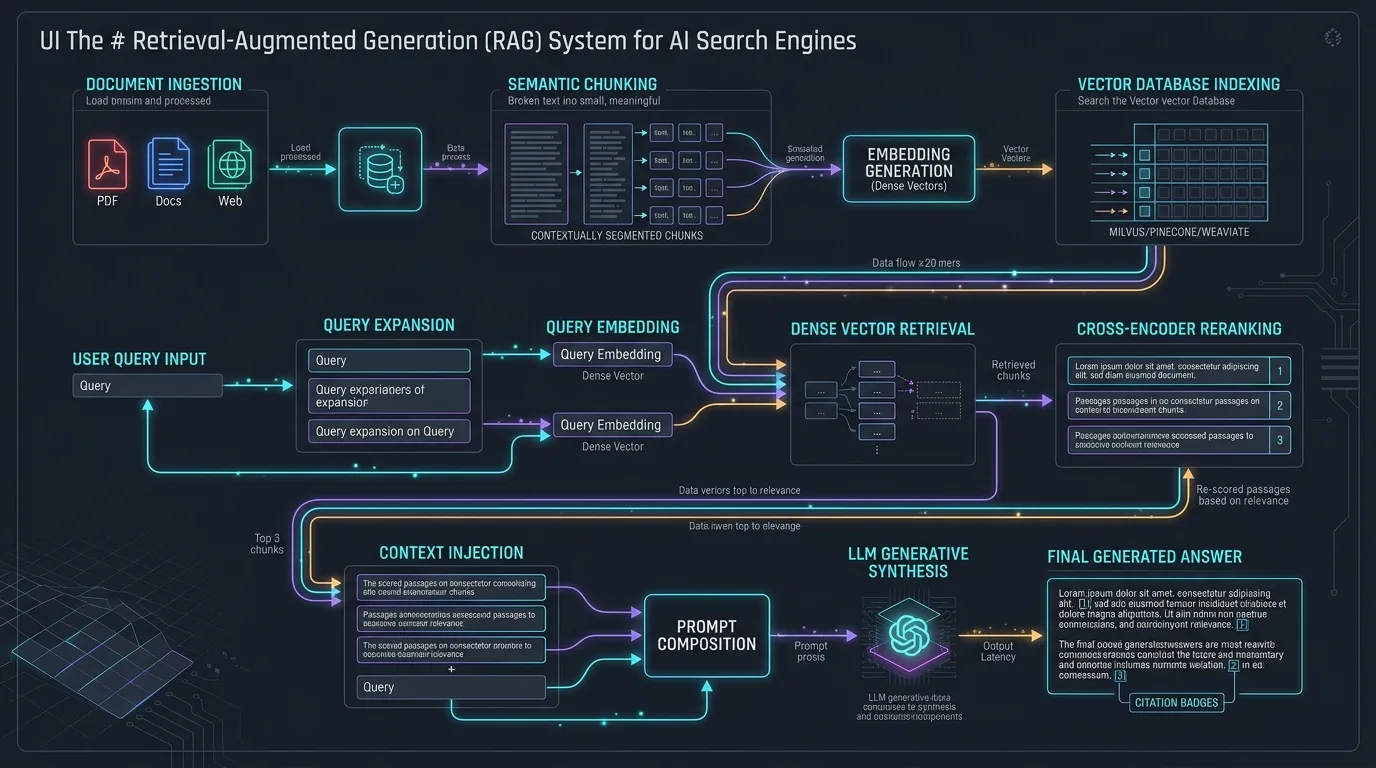
Google AI Overviews are powered by a specialized, enterprise-scale Retrieval-Augmented Generation (RAG) pipeline paired with Google's Gemini multimodal foundation models. When a user submits an informational or commercial query, the search engine does not simply query a large language model from its static pre-trained weights. Doing so would trigger hallucinations, outdated facts, and severe latency.
Instead, Google executes a disciplined, multi-stage retrieval architecture:
- Query Expansion & Sub-Query Decomposition: The user's query is deconstructed into multiple semantic sub-queries. Complex inquiries (e.g., "Best enterprise headless CMS for multi-regional healthcare brands") are decomposed into component checks for security compliance, international routing, and headless API performance.
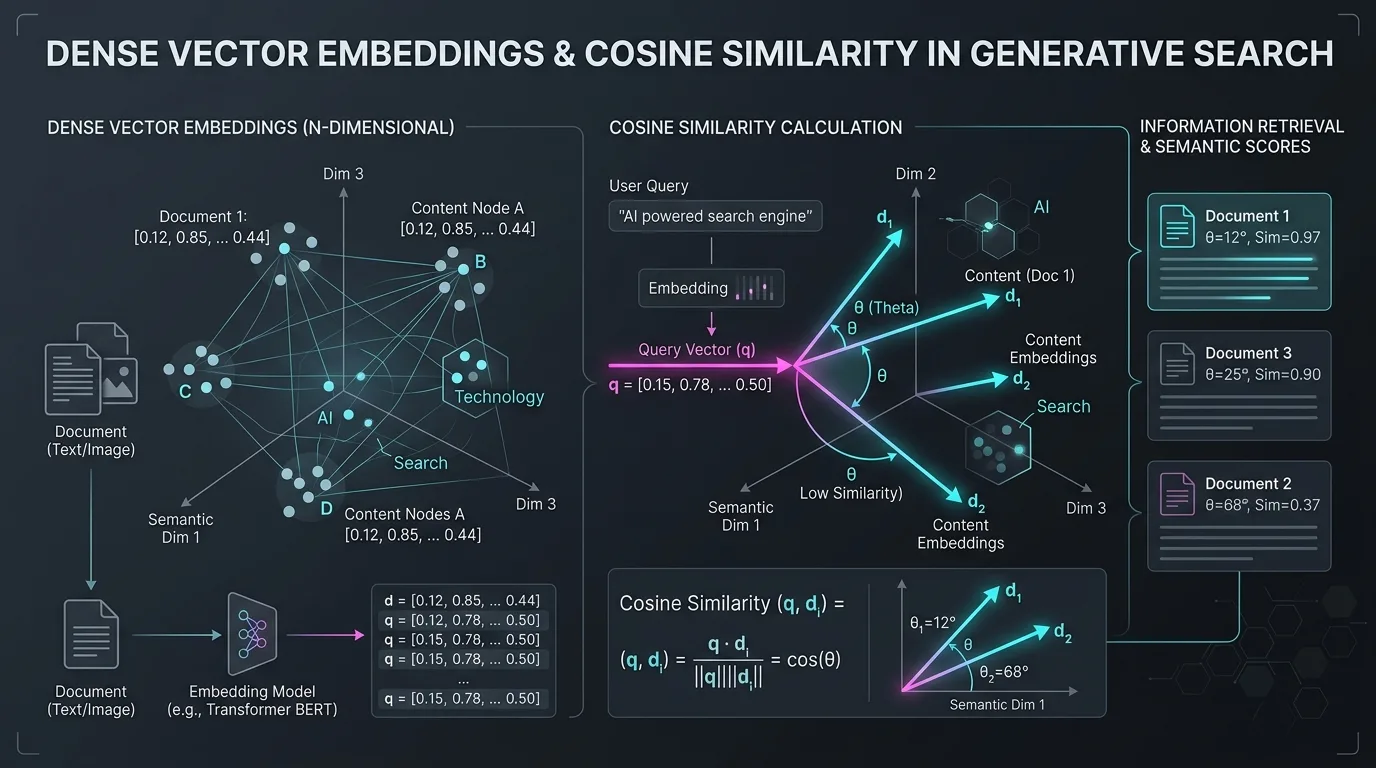
- Dense and Sparse Retrieval: Google's index retrieves the top 30 to 50 relevant document candidates using hybrid retrieval—combining traditional inverted indexes (BM25) with neural dense vector representations (RankEmbed).
- Passage Chunking and Salience Scoring: The retrieved documents are parsed into granular semantic passages (typically 150 to 300 words). Each passage is evaluated for factual density, information gain, and semantic relevance to the sub-queries.
- Gemini Context Injection & Synthesis: The highest-scoring passages are injected into the context window of Gemini's synthesis engine, which generates the conversational response while appending citation carousels and inline source pills.
2. The Direct Answer Structuring Framework: The Inverted Triangle
The primary reason high-ranking organic pages are excluded from Google AI Overviews is narrative burying. Traditional SEO copywriters often open articles with flowery introductions, rhetorical questions, and historical background before addressing the central query 800 words down the page. While human readers may tolerate this structure, LLM passage extractors will discard the document because the vector distance between the query and the opening text is excessively wide.
The Inverted Triangle Formula for AI Extraction
To guarantee that Google's neural parsers extract your content for AI Overview inclusion, structure every core heading using the Inverted Triangle formula:
- The 45-Word Direct Definition (The Apex): The immediate sentence following an H2 or H3 heading must directly answer the core question with definitive authority. Use subject-verb-object syntax without hedging adverbs (e.g., "Interaction to Next Paint (INP) is a Core Web Vital metric that measures the overall responsiveness of a page by evaluating the latency of all discrete user interactions...").
- The Structural Syntheses (Lists & Steps): Immediately follow the direct definition with an ordered or unordered list of 3 to 5 clear, bulleted mechanisms or criteria. LLMs exhibit a heavy structural bias toward lists because they are easy to compress into bulleted overview takeaways.
- The Granular Elaboration (Deep Telemetry): Provide the supporting practitioner evidence, mathematical benchmarks, case telemetry, and configuration examples that substantiate the direct answer.
3. Information Gain and the Anti-Regurgitation Penalty
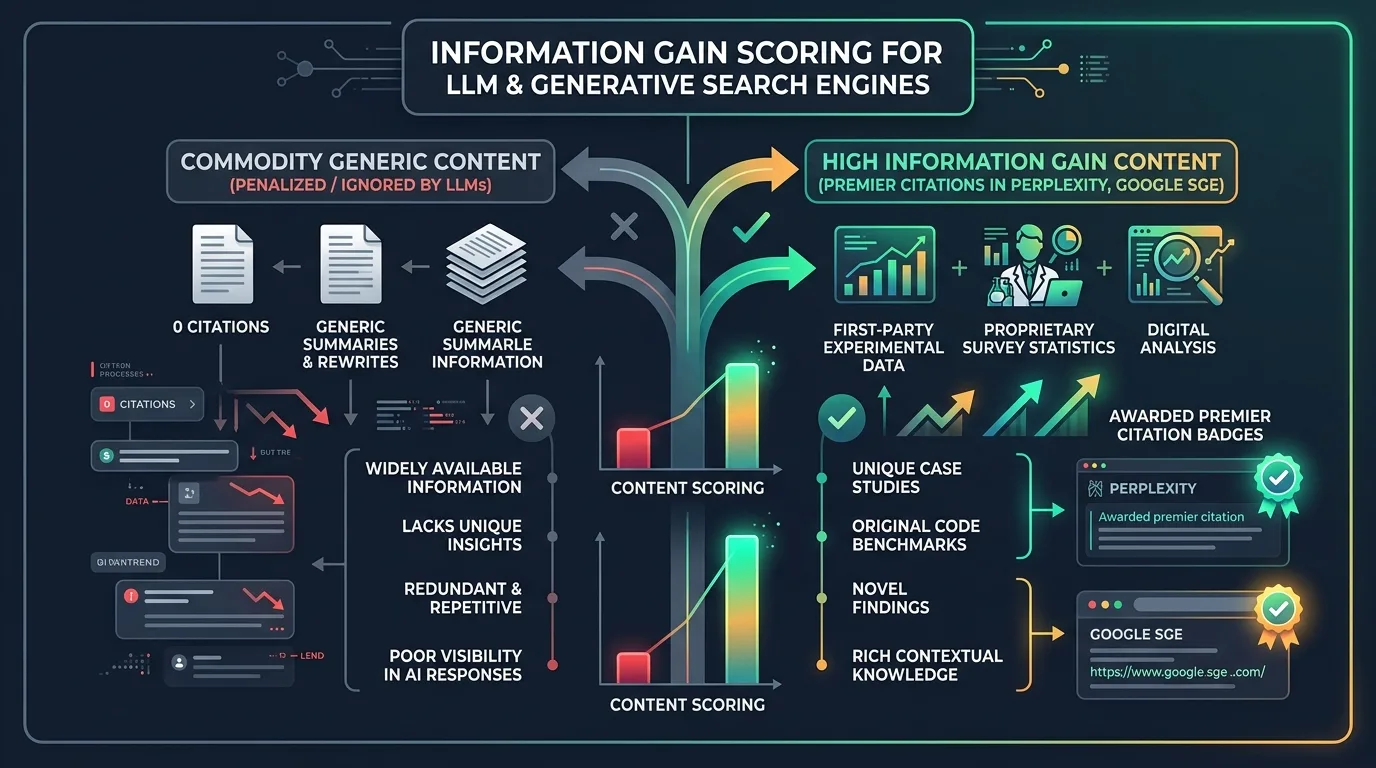
In 2024 and 2025, Google secured multiple patents specifically governing "Information Gain in Document Search." The core algorithm compares the semantic vector embeddings of a newly crawled page against the cluster of documents already ranked in the top 10 SERP positions.
If your article contains 90% identical semantic information to existing articles—even if written with completely original phrasing—the algorithm assigns it a near-zero Information Gain score. As explored in our analysis of modern keyword research methodology, regurgitated summaries are systematically excluded from AI Overviews. Only pages that inject novel data vectors, proprietary benchmarks, or contrarian practitioner frameworks earn prominent citation cards.
The Mathematics of Semantic Novelty
In technical information theory, Information Gain can be quantified as the relative entropy (Kullback-Leibler divergence) between the probability distribution of known entities in the existing search index and the distribution introduced by your newly published document:
- Entropy Reduction: A document that answers open edge cases or resolves conflicting facts reduces the searcher's total cognitive entropy, scoring exceptionally high on Gemini's quality gates.
- Novel Entity Triples: Injecting unique Subject-Predicate-Object triplets (e.g., specific telemetry numbers or unpublished incident post-mortems) expands the vector space beyond existing corpora.
- First-Party Attribution Density: Documents that cite original telemetry, proprietary survey datasets, or internal engineering repos are weighted with higher prior probabilities during RAG candidate filtering.
4. Generative Engine Optimization (GEO) vs Traditional Technical SEO
Review the fundamental strategic shifts required to move from keyword-centric SEO to generative AI retrieval in Table 1 below:
| Optimization Parameter | Traditional Organic SEO | Generative Engine Optimization (GEO) |
|---|---|---|
| Target Unit | Whole URL / Complete Web Page | Modular Semantic Passage / 200-Word Chunk |
| Primary Crawler Mechanism | Lexical token matching (BM25) and keywords | Multimodal dense vector embeddings and cosine similarity |
| Content Architecture | Long-form narrative with delayed conclusions | Inverted Triangle with direct 45-word apex answers |
| Authority Verification | PageRank, domain backlink profile, anchor text | Entity Knowledge Graph reconciliation and expert citations |
| Competitive Moat | Domain age, crawl budget, and raw word count | Information Gain score and proprietary empirical datasets |
| Traffic Outcome | Direct organic click to top-10 blue link | Primary source citation card, inline pill, and brand authority |
5. Structuring Machine-Readable Schema and Micro-Formats
While large language models are capable of parsing unstructured HTML, structured data markup drastically reduces computational ambiguity during the passage extraction phase. Implementing clean JSON-LD schemas provides search engines with verifiable entity relationships.
{
  "@context": "https://schema.org",
  "@graph": [
    {
      "@type": "TechArticle",
      "headline": "Optimizing Content for Google AI Overviews (SGE)",
      "description": "Comprehensive engineering guide for Generative Engine Optimization (GEO), direct answer structuring, and Gemini RAG extraction.",
      "inLanguage": "en-US",
      "about": [
        {
          "@type": "Thing",
          "name": "Generative Engine Optimization",
          "sameAs": "https://en.wikipedia.org/wiki/Generative_engine_optimization"
        },
        {
          "@type": "Thing",
          "name": "Retrieval-Augmented Generation",
          "sameAs": "https://en.wikipedia.org/wiki/Retrieval-augmented_generation"
        }
      ],
      "mentions": [
        {
          "@type": "SoftwareApplication",
          "name": "Google Gemini",
          "applicationCategory": "Artificial Intelligence"
        }
      ]
    }
  ]
}
6. Formatting Data Tables and Comparison Syntheses for AI Summaries
Google AI Overviews frequently generate comparative matrices when queries exhibit commercial evaluation intent (e.g., "Compare Cloudflare Workers vs AWS Lambda@Edge for dynamic SEO headers"). If your article presents comparisons using narrative paragraphs, Gemini must expend extra tokens interpreting the relationship. In contrast, clean HTML5 tables with semantic th headers and distinct rows are ingested and displayed directly inside AI Overview comparison carousels.
7. Automated Passage Scoring: Simulating RAG Extraction with Python
To evaluate whether your article's passages will score high enough to be selected by Google's dense retrieval models, content teams can simulate vector embedding extraction using open-source embedding models. By computing the cosine similarity between your draft passages and target user queries, you can detect passage bloat and optimize phrasing before publication:
# Passage Cosine Similarity Evaluator for GEO
import numpy as np
from sentence_transformers import SentenceTransformer

# Load high-performance sentence embedding model
model = SentenceTransformer('all-MiniLM-L6-v2')

target_query = "How does Google AI Overviews select source articles?"

passages = [
    "Google AI Overviews uses a Retrieval-Augmented Generation (RAG) pipeline paired with Gemini models. It deconstructs queries into semantic vectors, retrieves candidate documents using hybrid BM25 and dense embeddings, chunks passages into 200-word segments, and synthesizes answers based on factual density and Information Gain.",
    "Search engine optimization has changed a lot in recent years. Nowadays, artificial intelligence is very important for websites and many people wonder how Google decides what to show users in search results."
]

query_embedding = model.encode(target_query)
passage_embeddings = model.encode(passages)

def cosine_similarity(a, b):
    return np.dot(a, b) / (np.linalg.norm(a) * np.linalg.norm(b))

for i, p in enumerate(passages):
    score = cosine_similarity(query_embedding, passage_embeddings[i])
    print(f"Passage {i+1} Cosine Score: {score:.4f}")
    # Score > 0.75 indicates high eligibility for AI Overview extraction
8. Entity Disambiguation and Wikidata Knowledge Reconciliation
Google's foundational models rely heavily on the internal Knowledge Graph to verify factual consistency. If your content references terms that lack clear entity disambiguation, the model's confidence threshold decreases, reducing the likelihood of citation.
To maximize entity confidence:
- Anchor Entities to Canonical URIs: Use Schema.org
sameAsarrays to link entities mentioned in your text to their canonical Wikidata (wikidata.org/wiki/Q...) or Wikipedia identifiers. - State Explicit Semantic Triples: Formulate sentences that clearly establish Subject-Predicate-Object relationships (e.g., "Google [Subject] deployed [Predicate] Gemini 1.5 Pro [Object] within Search Generative Experience.").
- Maintain Topical Cohesion: Ensure that entities within a cluster reinforce one another rather than drifting across unrelated domains, preventing dilution of your site's topical authority graph.
9. Key Performance Indicators (KPIs) for Generative Search Tracking
Tracking the efficacy of your Generative Engine Optimization requires moving beyond standard Search Console average position metrics. Table 2 outlines the primary measurement framework for AI Overview visibility in 2026:
| Generative Search Metric | Definition & Methodology | Diagnostic Significance | Target Performance |
|---|---|---|---|
| AI Overview Citation Rate | Percentage of priority tracked queries triggering an AI Overview where your URL is cited | Measures entity salience and information gain strength | > 45% in core cluster topics |
| Carousel Position #1-3 Share | Share of citations appearing in the top 3 cards of the horizontal source drawer | Directly dictates click-through volume from AI boxes | > 60% of triggered citations |
| Inline Pill Inclusion | Presence of your brand domain as an inline clickable citation pill within the generated prose | Highest-converting referral source in generative interfaces | Present on all Tier-1 commercial keywords |
| Zero-Click Brand Impressions | Search Console impression growth on high-volume queries with stable or declining clicks | Indicates top-of-mind brand attribution without site visits | Consistent month-over-month expansion |
| Post-Summary Click Velocity | Clicks occurring after a user expands an AI Overview accordion | Demonstrates high intent and qualified prospect discovery | > 15% increase in session duration |
For technical teams monitoring client-side rendering bottlenecks that might prevent Google's headless crawlers from accessing your direct answer passages, review our guide on optimizing Interaction to Next Paint (INP) and main thread bottlenecks.
10. The 6-Step Checklist for AI Overview Content Optimization
Execute this practical checklist on every priority landing page and cluster article to optimize for AI Overviews:
- Lead with a 45-Word Declarative Answer: Place the direct answer to the primary search query within the first 100 pixels of the main content container.
- Use Unambiguous Entity Naming: Eliminate vague pronouns ("it," "this tool," "they"). Always state explicit entity names ("Google Search Console," "Next.js App Router," "Cloudflare CDN") to maximize entity recognition confidence.
- Format Key Takeaways as Bulleted Syntheses: Present critical steps, criteria, or pros/cons as concise HTML unordered lists immediately following core concepts.
- Publish High-Resolution Technical Diagrams: Embed custom dark-mode schematics with descriptive alt attributes and caption tags. Gemini models are multimodal and frequently cite images directly in AI carousel previews.
- Maintain Clean Semantic HTML: Avoid burying critical answers inside obfuscated shadow DOM trees, client-only modals, or deeply nested div structures.
- Provide Proprietary Empirical Data: Include at least one original statistic, telemetry benchmark, or production code implementation that cannot be found elsewhere on the web.
11. Frequently Asked Questions (FAQ)
What are Google AI Overviews and how do they work?
Google AI Overviews (formerly SGE) are synthetic, AI-generated search summaries powered by Google's Gemini models. They use Retrieval-Augmented Generation (RAG) to extract relevant passages from high-authority web documents, synthesize an answer directly on the search results page, and provide citation links to source websites.
How can my website be featured as a source in Google AI Overviews?
To be featured, your content must provide high Information Gain, direct answers formatted within the first 45 words of headings, clean HTML lists or tables, authoritative entity references, and fast, crawlable technical performance. Pages must already rank well organically in the top 30 to 50 search results.
Do AI Overviews decrease organic search traffic to websites?
For simple, factual informational queries (such as currency conversions, weather, or short definitions), AI Overviews significantly increase zero-click searches. However, for complex commercial, technical, and evaluation queries, being cited as a primary source inside the AI Overview drives exceptionally qualified, high-intent referral traffic.
What is Generative Engine Optimization (GEO)?
Generative Engine Optimization (GEO) is the practice of optimizing digital content and technical architecture specifically for retrieval, citation, and recommendation by AI-driven search engines and large language models (such as Google Gemini, OpenAI Search, and Perplexity).
How does Google determine Information Gain?
Google calculates Information Gain by comparing the semantic vector embeddings of a page against documents already ranked for the query. If a page provides novel data, fresh case studies, original technical diagrams, or unique analytical perspectives absent from existing corpora, it receives a higher Information Gain score.
Why is sentence-level clarity critical for AI Overview extraction?
Large language models extract passages in semantic chunks. When a sentence is overly convoluted, filled with marketing jargon, or reliant on pronouns, the model struggles to verify factual confidence. Clear, declarative subject-verb-object structures achieve significantly higher extraction confidence.
Do structured data schemas directly trigger AI Overview citations?
While schema markup alone does not guarantee an AI Overview citation, it removes factual ambiguity by explicitly defining entities, authors, dates, and topics. This allows Google's dense retrieval models to map your content directly to the Knowledge Graph with high confidence.
Can blocking Google-Extended in robots.txt prevent AI Overview scraping?
No. Google-Extended only controls data collection for training Google Gemini foundational models. Google AI Overviews are generated as part of Google Search, which uses the standard Googlebot crawler. Disallowing Googlebot will remove your site from both AI Overviews and standard organic search entirely.
How do HTML tables improve chances of being cited in commercial AI Overviews?
AI search models prioritize structured tables when synthesizing commercial comparisons and product feature matrices. Tables eliminate the need for the model to extract and align unstructured textual claims, making them ideal for direct inclusion in comparative AI answer widgets.
How frequently does Google update the AI Overviews source index?
AI Overviews draw from Google's live search index. When fresh information or breaking industry updates are detected, Google's RAG pipeline can dynamically incorporate newly crawled and indexed articles within minutes to hours, rewarding websites that publish authoritative, timely analysis.



Ratings & reviews
No reviews yet. Be the first.