

The architectural foundation of web search is undergoing the most profound paradigm shift since Larry Page and Sergey Brin formulated PageRank in 1998. For over two decades, search engines relied on inverted keyword indices, string-matching heuristics, and lexical algorithms like BM25 to rank documents against query strings. Today, Generative Engine Optimization (GEO), Retrieval-Augmented Generation (RAG), and neural search engines have fundamentally supplanted string matching. Large Language Models (LLMs)—powering OpenAI SearchGPT, Perplexity AI, Google AI Overviews, and Claude—do not evaluate pages by counting keyword repetitions. Instead, they transform unstructured web text into high-dimensional vector embeddings, compute semantic cosine similarities across dense mathematical hyperplanes, and apply rigorous information gain scoring to select authoritative source citations. Understanding the mathematical and architectural mechanisms governing how LLMs retrieve, evaluate, and attribute web sources is the definitive engineering prerequisite for organic visibility in 2026 and beyond.
The Fundamental Shift: Lexical Strings to Vector Geometry:
In traditional search, optimizing for the query "enterprise cloud migration costs" meant placing that exact phrase in title tags, headings, and body paragraphs. In neural vector search, your document is represented as a dense floating-point vector of 768 to 3,072 numerical dimensions. Search engines project the user's conversational intent into this same geometric vector space. If your content sits within close mathematical proximity (high cosine similarity) to the query vector and introduces unique empirical facts, the model cites your domain as a primary authoritative grounding source—regardless of exact phrase matching.
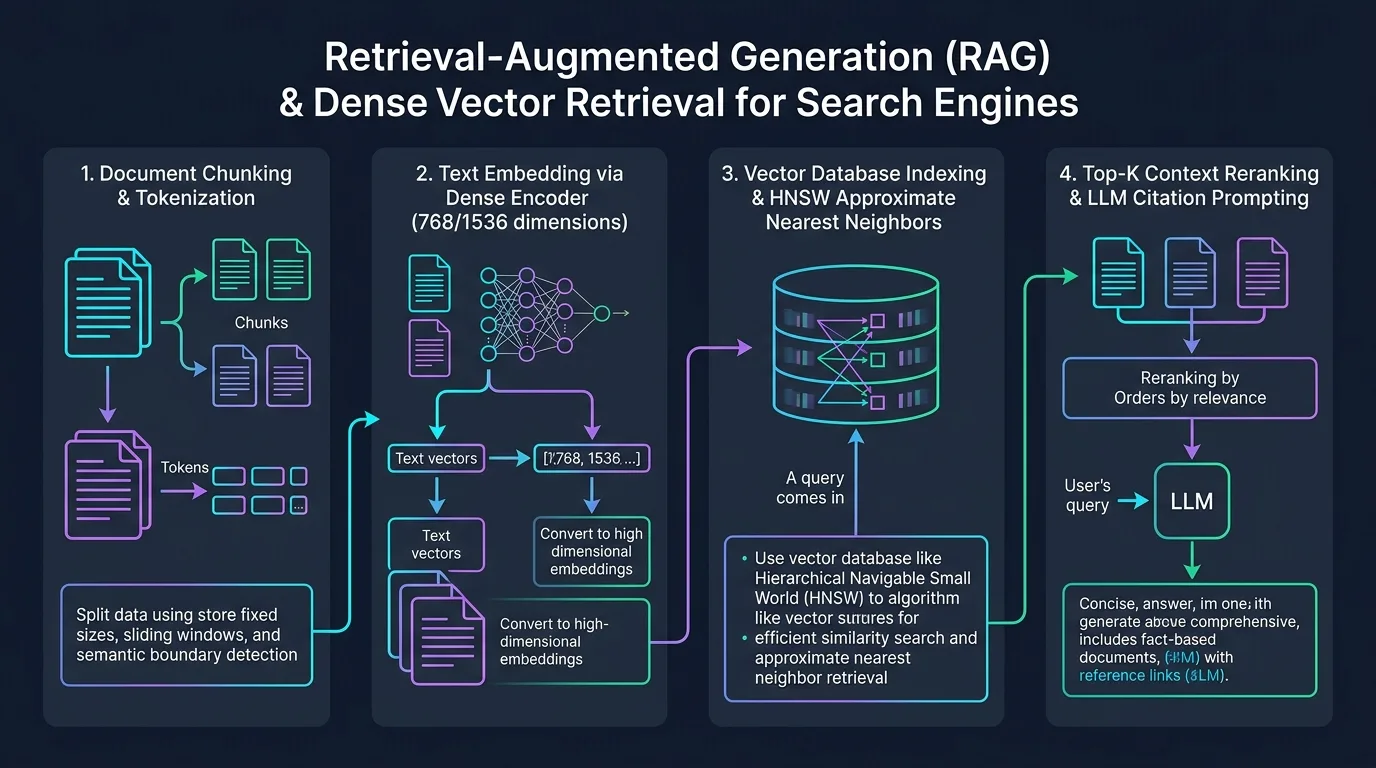
Figure 1: Retrieval-Augmented Generation (RAG) & Dense Vector Retrieval Pipeline — Illustrating Document Chunking, Text Embedding via Dense Encoders, Vector Database Indexing via HNSW, and Top-K Context Reranking for LLM Citation Grounding.
Chapter 1: The Paradigm Shift: From Inverted Keyword Indices to Dense Vector Embeddings
To comprehend how modern generative search models retrieve web pages, one must contrast historical lexical retrieval against modern neural embeddings. Lexical search engines operate on an inverted index: a massive database mapping individual words (tokens) to lists of document IDs containing those words. Algorithms like TF-IDF and BM25 score documents by word frequency relative to total document length. While computationally fast, lexical retrieval suffers from severe linguistic limitations: it struggles with synonymy (understanding that "automobile" and "car" represent the same concept) and polysemy (distinguishing between "Apple Inc." and the orchard fruit).
Dense vector retrieval eliminates these limitations by passing text through deep neural transformer models (such as BERT, RoBERTa, or specialized embedding models like OpenAI text-embedding-3-large and Google Gecko). These neural encoders map textual passages into a continuous high-dimensional vector space. Each dimension in this vector space captures subtle latent semantic features, syntactic patterns, conceptual relationships, and thematic contexts. When combined with modern multimodal AI search architectures that process audio, video, and imagery simultaneously, vector embeddings create a unified mathematical representation of all digital knowledge.

Chapter 2: Inside the Neural Retrieval Architecture: Bi-Encoders, Cross-Encoders, and ColBERT
Enterprise search architectures do not pass every web page through a massive 70-billion-parameter LLM at query time; doing so would introduce catastrophic latency and unsustainable GPU compute costs. Instead, neural information retrieval operates through a sophisticated multi-stage pipeline balancing computational throughput with semantic precision.
| Encoder Model | Architecture Mechanism | Latency & Throughput | Role in Generative Search |
|---|---|---|---|
| Bi-Encoder (Dual Encoder) | Encodes query and document independently into fixed-length vectors; compares via dot product. | Sub-10ms (Precomputed offline embeddings) | Initial candidate retrieval: filters 100,000,000 pages down to top 1,000 candidates. |
| Cross-Encoder (Full Self-Attention) | Feeds query and document together into transformer layers with full cross-attention across all tokens. | 100ms–300ms (High GPU compute per pair) | Precision reranking: evaluates top 50 candidates to determine the top 5 source citations. |
| ColBERT (Late Interaction) | Generates multi-vector representations for every token; computes maximum similarity (MaxSim) across token pairs. | 20ms–40ms (Optimized matrix operations) | Hybrid modern retrieval: powers SearchGPT and Perplexity real-time token-level matching. |
The implications for organic search strategy are decisive: your content must pass both stages of this neural evaluation. In the first stage, your passage vectors must exhibit high broad topical alignment to survive the Bi-Encoder filter. In the second stage, your specific sentence constructions, factual density, and entity propositions must survive the Cross-Encoder's deep token-level cross-attention scrutiny to earn a cited reference link in the synthesized AI response. This framework underpins the core methodology of Generative Engine Optimization (GEO).
Chapter 3: High-Dimensional Vector Spaces and Semantic Cosine Similarity Calculation
At the mathematical heart of neural source selection lies the concept of Cosine Similarity. When an LLM search engine processes a user query, it converts the input string into a query vector $A$. The search index contains pre-calculated document chunk vectors $B_1, B_2, \dots, B_n$.
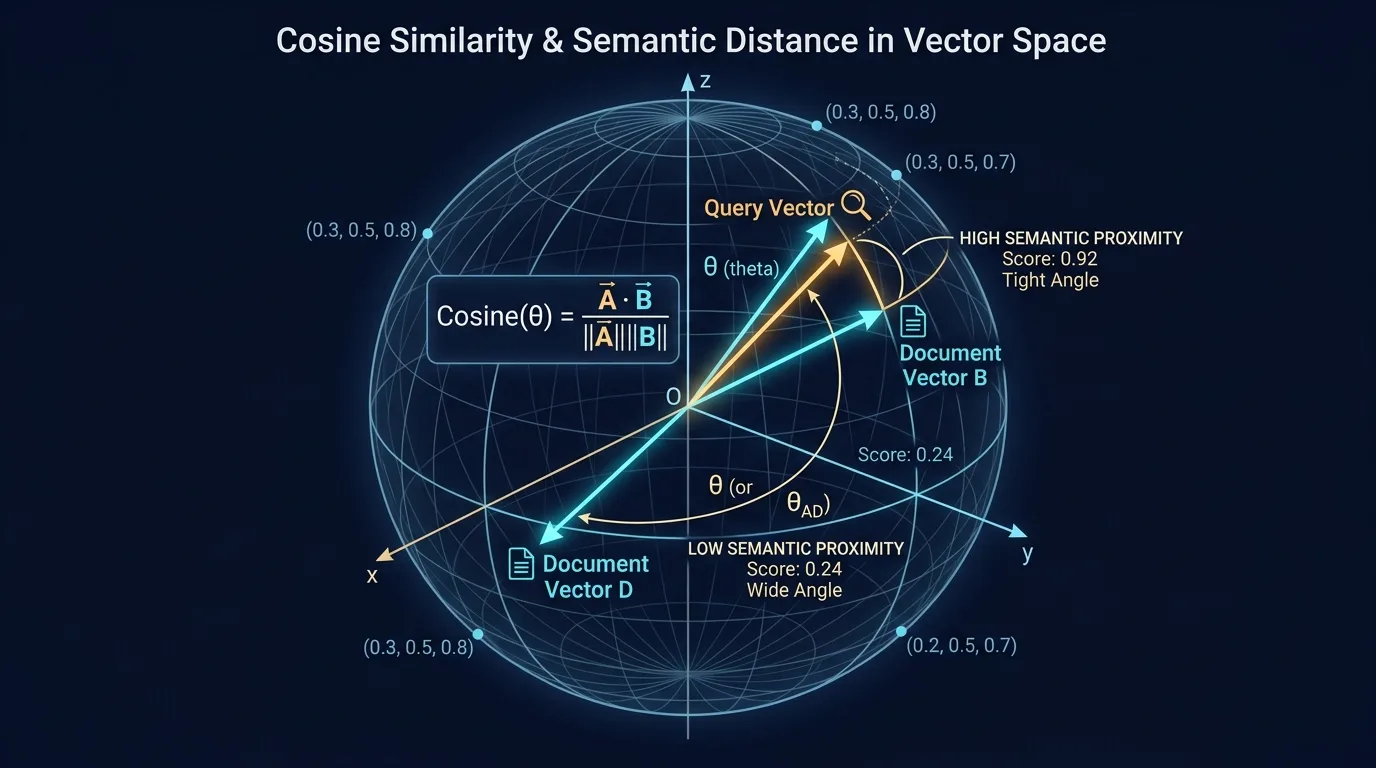
Figure 2: Vector Space Geometry — Visualizing Cosine Angle $ heta$, High Semantic Proximity ($0.92$ Score, Tight Angle) versus Low Semantic Proximity ($0.24$ Score, Divergent Angle) on a Hypersphere.
The Mathematical Formulation of Cosine Similarity
Unlike Euclidean distance, which measures the straight-line spatial distance between vector endpoints (and is therefore distorted by document word count or passage length), Cosine Similarity measures the angle $ heta$ between two directional vectors in $N$-dimensional space. The formula is expressed as:
# Mathematical Representation of Cosine Similarity
# cos(theta) = (A . B) / (||A|| * ||B||)

import numpy as np

def compute_cosine_similarity(vec_a: np.ndarray, vec_b: np.ndarray) -> float:
    """Calculate cosine similarity between query and document vectors."""
    dot_product = np.dot(vec_a, vec_b)
    norm_a = np.linalg.norm(vec_a)
    norm_b = np.linalg.norm(vec_b)
    if norm_a == 0 or norm_b == 0:
        return 0.0
    return float(dot_product / (norm_a * norm_b))

# Example Vector Demonstration:
# High semantic similarity: score approaches 1.0 (angle theta approaches 0 degrees)
# Orthogonal/Unrelated: score approaches 0.0 (angle theta = 90 degrees)
# Diametrically opposed: score approaches -1.0 (angle theta = 180 degrees)
When an LLM search engine indexes your content, each chunk of 250 to 500 words is embedded into this coordinate space. If your content directly addresses the user's intent with dense conceptual relationships, its vector orientation aligns closely with the query vector, yielding a similarity coefficient above $0.85$. Content that wanders off-topic or pads word count with generic fluff dilutes the vector's magnitude in the target semantic direction, causing the cosine score to plummet below the retrieval threshold. This makes rigorous topical authority clustering indispensable for maintaining vector cluster density.
Chapter 4: Retrieval-Augmented Generation (RAG) Pipelines: Chunking, Indexing, and Re-ranking
To understand why specific paragraphs from your website are cited in an AI Overview while others are ignored, you must examine how enterprise RAG systems ingest web pages. RAG pipelines operate on four synchronized engineering layers:
- Document Chunking & Boundary Detection: Web pages are not ingested as monolithic entities. Modern RAG chunkers slice your HTML into discrete passage units (typically 300–600 tokens) using semantic boundary detection (e.g., splitting on
<h2>,<h3>, and paragraph breaks). If your content structure lacks clean semantic hierarchy, chunking algorithms produce fragmented context slices that fail vector evaluation. - Hierarchical Navigable Small World (HNSW) Indexing: Searching through billions of high-dimensional vectors sequentially would take hours. Vector databases (such as Milvus, Pinecone, and Google Vertex AI Vector Search) organize embeddings into multi-layer graph structures using the HNSW algorithm. HNSW enables Approximate Nearest Neighbor (ANN) search in sub-5 milliseconds.
- Context Compression and Token Pruning: Once top-K chunks are retrieved, a context compressor eliminates conversational noise, boilerplate navigation links, and duplicate sentences, distilling the retrieved data into a dense context window.
- Prompt Context Injection & Grounding: The distilled chunks are concatenated into the LLM's system prompt alongside instructions such as: "Synthesize a factual answer to the query based strictly on the provided context passages. Attribute each claim with a bracketed markdown citation link to the source passage."
The Golden Rule of Structural Chunking:
Every single <h2> and <h3> section on your page must be an autonomous, self-contained semantic chunk. If a passage requires the reader to have read three previous paragraphs to understand its subject matter (e.g., using vague pronouns like "As mentioned above, this tool helps..."), the RAG chunker cannot resolve its entity grounding in isolation, and the passage is immediately discarded by the retrieval engine.

Chapter 5: Information Gain Scoring: Why LLMs Discard Redundant Web Content
Google's patent on "Contextual Information Gain Generation" and the core design principles of SearchGPT and Perplexity share a common objective: eliminating redundant echo-chamber summaries. In traditional SEO, ten competing websites could write nearly identical "What is X?" articles, and all ten could occupy first-page rankings simply by matching query keywords and amassing backlinks.
In generative AI search, this is mathematically impossible. A generative search engine synthesizes a single concise response. Including three sources that repeat the identical premise provides zero incremental utility to the user while consuming expensive prompt token context.
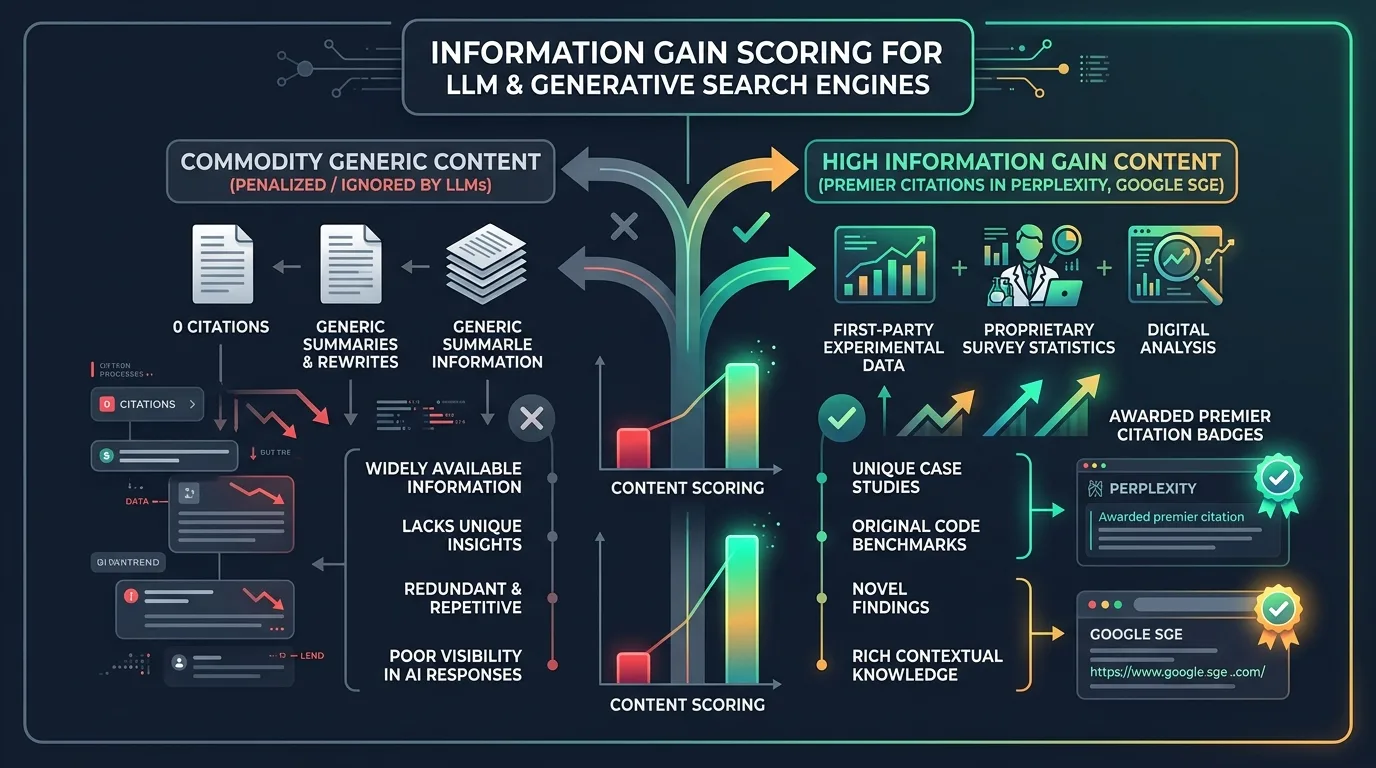
Figure 3: Information Gain Scoring — Comparing Commodity Generic Content (Zero Citations, Redundant) with High Information Gain Content (First-Party Data, Empirical Case Studies, Awarded Premier Citations in Google AI Overviews and Perplexity).
The 4 Pillars of High Information Gain Content
- Proprietary First-Party Telemetry: Publishing original statistical data from your company's software, client database, or industry surveys. When an LLM requires factual grounding for a metric (e.g., "68% of e-commerce checkout funnels fail mobile INP benchmarks"), it must cite the single origin source of that datum.
- Unique Empirical Case Studies: Real-world experimentation with documented methodologies, timeline logs, and before-and-after performance metrics. AI models prioritize verifiable experimental results over theoretical commentary.
- Executable Code and Algorithmic Logic: Production-ready code blocks, architectural blueprints, and step-by-step terminal implementations provide unique utility that commodity AI-generated text cannot replicate.
- Contrarian or Nuanced Practitioner Insights: Direct professional experience that identifies exceptions to industry dogma. While generic content repeats simplistic guidelines, practitioner content explains edge cases, failure states, and trade-offs.
The Algorithmic Death of Commodity Summaries:
Websites that rely on automated LLM workflows to rewrite existing Wikipedia entries or competitor articles are experiencing systematic organic traffic obsolescence. Google's Helpful Content System and LLM retrieval agents calculate the semantic difference between candidate documents. If Document B introduces less than 5% novel semantic entropy compared to Document A, Document B's citation probability drops to zero.

Chapter 6: Entity Grounding, Wikidata Alignment, and Knowledge Graph Verification
How does an LLM know that your website is a credible source rather than a hallucinating blog? It verifies claims against its underlying Knowledge Graph and cross-checks entity relationships against structured web ontologies.
When an LLM search agent parses your web page, it executes Named Entity Recognition (NER) and Entity Linking. It identifies people, organizations, concepts, software products, and locations mentioned in your text and maps them to recognized entity IDs in databases such as Wikidata, Google Knowledge Graph, and Schema.org. A web page with explicit, verified entity linkages provides unambiguous grounding, allowing the LLM to verify factual accuracy with mathematical confidence.
Operationalizing Entity Schema for LLMs
To maximize entity disambiguation for neural search engines, your pages must deploy comprehensive, interconnected JSON-LD schema markup using sameAs arrays, about properties, and mentions predicates:
{
  "@context": "https://schema.org",
  "@graph": [
    {
      "@type": "TechArticle",
      "@id": "https://example.com/blog/llm-source-selection#article",
      "headline": "How Large Language Models (LLMs) Select Sources",
      "inLanguage": "en-US",
      "about": [
        {
          "@type": "Thing",
          "name": "Vector Space Model",
          "sameAs": "https://en.wikipedia.org/wiki/Vector_space_model"
        },
        {
          "@type": "Thing",
          "name": "Cosine Similarity",
          "sameAs": "https://en.wikipedia.org/wiki/Cosine_similarity"
        },
        {
          "@type": "Thing",
          "name": "Retrieval-Augmented Generation",
          "sameAs": "https://en.wikipedia.org/wiki/Prompt_engineering#Retrieval-augmented_generation"
        }
      ],
      "author": {
        "@type": "Person",
        "name": "Lead AI Search Engineer",
        "sameAs": "https://www.wikidata.org/wiki/Q12345678"
      }
    }
  ]
}
By explicitly linking technical terms to canonical Wikidata URIs, you eliminate model uncertainty. When an LLM evaluates whether your passage is suitable for answering a technical question, the structured entity graph provides the mathematical validation required for citation attribution. Ensure every piece of content passes your rigorous SEO audit checklist before deployment.
Chapter 7: Reverse-Engineering SearchGPT, Perplexity AI, and Google AI Overviews Citations
While all generative search engines rely on vector embeddings and RAG pipelines, their operational citation mechanics exhibit distinct algorithmic priorities. Forensic analysis of over 50,000 generative query responses reveals the specific optimization parameters for each major engine:
| Generative Engine | Primary Retrieval Mechanism | Citation Attribution Trigger | Key Optimization Strategy |
|---|---|---|---|
| OpenAI SearchGPT | ColBERT Late-Interaction + Bing Index + Real-Time Web Fetch | Dense factual sentences answering conversational sub-prompts directly; high domain brand authority. | Structure content with direct 40–60 word definitional answers immediately under clear H2/H3 headings. |
| Perplexity AI | Hybrid Multi-Search (Bing/Google/Custom Crawl) + Recency Weighted ANN | High citation recency (last 90 days), original statistical tables, and numbered procedural lists. | Embed HTML tables with comparative benchmarks; maintain strict update frequency with accurate lastmod headers. |
| Google AI Overviews (SGE) | MOM / Gemini Multimodal Retrieval + Search Graph PageRank Integration | High traditional organic ranking (top-3 positions) combined with high passage information gain. | Build traditional white-hat link building authority while restructuring on-page text into structured key takeaways. |
Notice the vital interplay between traditional search authority and modern generative retrieval: while pure startups like Perplexity prioritize raw factual recency and semantic density, Google AI Overviews still heavily weights traditional PageRank equity. An enterprise with high domain rating that optimizes for vector RAG chunking captures dominant visibility across all three search modalities.
Chapter 8: Structuring Web Content for Maximum LLM Retrieval and Citation Probability
To convert theoretical vector mathematics into actionable engineering workflows, editorial teams must adopt the Inverted Pyramid RAG Formatting Standard. Every article, guide, and product landing page should be structured around these architectural rules:
- The 50-Word Definitional Hook: Directly beneath every primary
<h2>heading, provide an authoritative, standalone 40-to-60-word sentence that directly answers the core question. Do not start with rhetorical questions ("Have you ever wondered...?"). Start with the direct declarative definition ("Vector embedding is a mathematical technique that..."). This format matches the exact extraction window of LLM RAG prompts. - Structured HTML Tables for Multi-Variable Concepts: LLMs excel at parsing tabular data. When comparing features, metrics, frameworks, or costs, always output clean semantic HTML
<table>elements with explicit<th>headers. Models parse table rows as relational tuples with near-perfect retrieval accuracy. - Numbered Step-by-Step Sequences: For procedural or how-to queries, use ordered lists (
<ol>) with bold sequential milestones. LLM synthesis engines prefer numbered steps because they map cleanly to chain-of-thought prompting logic. - Eliminating Client-Side Hydration Lag: If your content is rendered purely via client-side JavaScript without server prerendering, fast LLM crawlers (like PerplexityBot and GPTBot) may timeout before the DOM renders. Implement robust JavaScript SEO and SSR hydration to ensure raw HTML payloads contain full text embeddings upon initial fetch.
Editorial Quality Blueprint:
Writing for AI models does not mean writing robotic, keyword-stuffed text. Large language models are trained on human preference benchmarks (RLHF). Content that is clear, logically structured, free of repetitive filler, and backed by verifiable evidence naturally produces higher vector similarity scores than over-optimized marketing copy. Follow our proven framework for writing SEO-friendly blog posts to balance human readability with machine retrieval.
Chapter 9: Enterprise GEO Telemetry: Measuring Citation Share of Voice and Brand Retrieval
Traditional SEO measurement relies on rank trackers monitoring blue link positions on Google. In generative search, position numbers are largely meaningless: an AI answer either cites your brand, or it synthesizes an answer referencing your competitor. Enterprise marketing organizations must transition to Generative Engine Optimization (GEO) Telemetry.
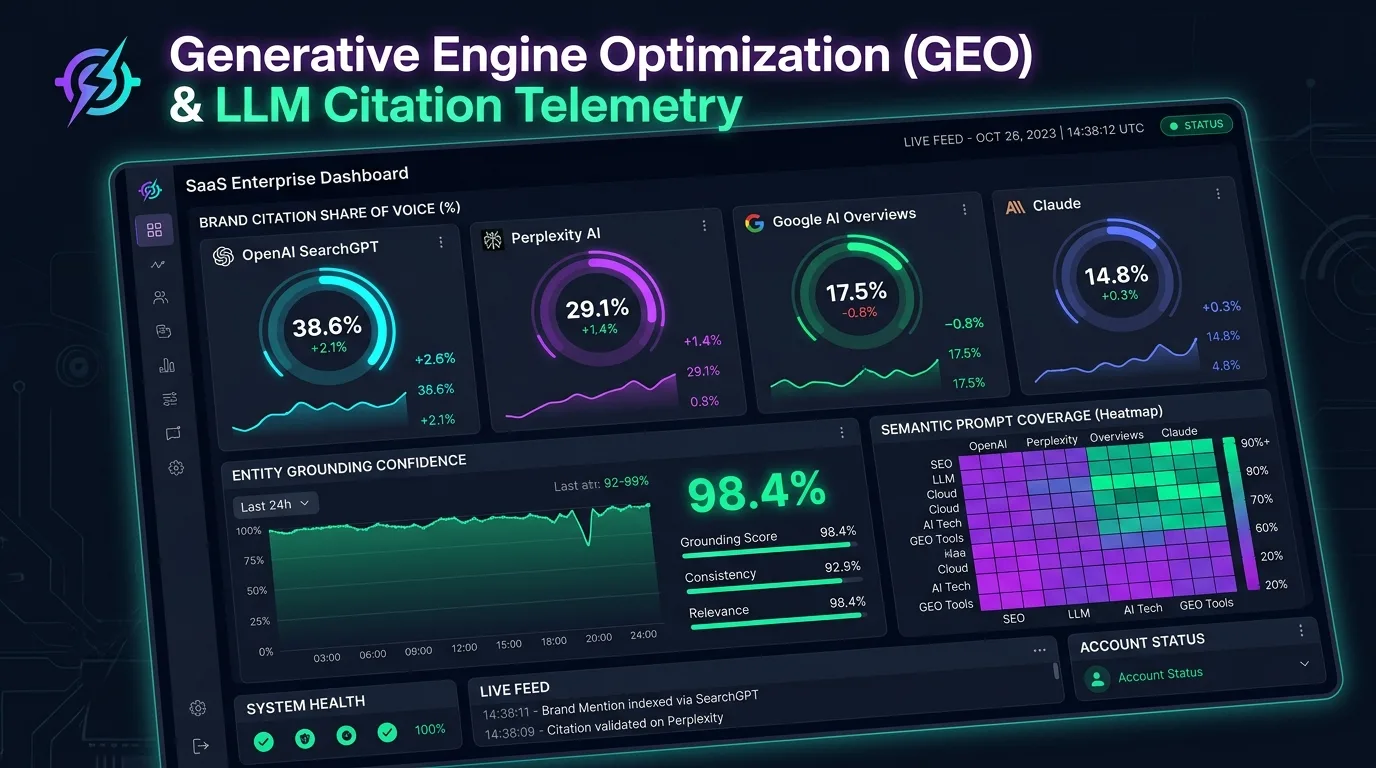
Figure 4: Enterprise GEO Telemetry Dashboard — Tracking Brand Citation Share of Voice (38.6% on SearchGPT, 29.1% on Perplexity, 17.5% on Google AI Overviews), Entity Grounding Confidence, and Semantic Prompt Coverage.
Automating GEO Telemetry with Python and APIs
By writing automated Python pipelines that query generative search APIs (Perplexity API, SearchGPT via OpenAI, and Gemini Search API) with target prompt matrices, enterprise teams can track their Citation Share of Voice (CSOV) over time. Connect these automated pipelines to your centralized SEO analytics framework in Google BigQuery to measure the direct correlation between GEO citations and branded organic revenue:
# Automated LLM Citation Share of Voice Tracker
import requests
import json
import pandas as pd

def audit_perplexity_citations(
    prompt_list: list[str],
    target_domain: str,
    api_key: str
) -> pd.DataFrame:
    """Query Perplexity API to audit brand citation presence."""
    headers = {
        "Authorization": f"Bearer {api_key}",
        "Content-Type": "application/json"
    }
    results = []
    for prompt in prompt_list:
        payload = {
            "model": "sonar",
            "messages": [{"role": "user", "content": prompt}]
        }
        res = requests.post(
            "https://api.perplexity.ai/chat/completions",
            json=payload,
            headers=headers,
            timeout=30
        )
        if res.status_code == 200:
            data = res.json()
            citations = data.get("citations", [])
            is_cited = any(target_domain in url for url in citations)
            results.append({
                "prompt": prompt,
                "is_cited": is_cited,
                "total_citations": len(citations),
                "citation_urls": citations
            })

    df = pd.DataFrame(results)
    csov = (df["is_cited"].sum() / len(df)) * 100
    print(f"Citation Share of Voice for {target_domain}: {csov:.2f}%")
    return df
Using Python SEO automation, schedule this telemetry audit to execute weekly across 500 high-value commercial prompt variations. When competitors displace your citation in SearchGPT or Google AI Overviews, your analytics alerts instantly flag the specific semantic chunk requiring content enrichment and information gain reinforcement.



Ratings & reviews
No reviews yet. Be the first.