

For more than a decade, digital content marketing operated under a simplistic, volume-driven playbook: publish three generic blog posts a week, target high-volume informational keywords, collect organic pageviews, and report vanity traffic metrics to executive leadership. In 2026, that playbook is dead. The convergence of generative AI search engines, zero-click answer boxes, and sophisticated B2B buying committees has rendered commodity blogging entirely obsolete. Today, enterprise content marketing must function as an unshakeable editorial engine engineered for one definitive business outcome: measurable organic pipeline and revenue.
High-growth companies do not treat content marketing as a top-of-funnel publishing factory. They treat content as a strategic revenue asset. By marrying technical search architecture with deep subject matter expertise, multi-channel distribution flywheels, and first-party data journalism, modern editorial engines build impenetrable brand moats that convert anonymous searchers into qualified enterprise buyers.
1. The Strategic Shift: Why Content Marketing Must Drive Pipeline, Not Just Pageviews
The traditional content marketing metric suite—pageviews, raw sessions, social shares, and newsletter signups—is facing a profound crisis of credibility in executive boardrooms. Chief Marketing Officers (CMOs) and Chief Financial Officers (CFOs) are no longer satisfied with reports demonstrating that blog traffic grew by 35% year-over-year if sales pipeline and customer acquisition remain stagnant.
This disconnect arises from the fundamental difference between traffic generation and commercial pipeline creation. Publishing broad, top-of-funnel "infotainment" content (e.g., "10 Motivational Quotes for Monday Morning" or generic definitions of industry terms) attracts high traffic volume composed almost entirely of college students, job seekers, and casual browsers who possess zero purchasing intent or budgetary authority.

A modern editorial engine focuses ruthlessly on Product-Led & Problem-Centric Content. Every published asset must sit squarely at the intersection of three vectors: what your target buyer is actively searching for, the acute commercial problem your software or service solves, and the unique, proprietary perspective your brand possesses. When content is engineered through this lens, even an article receiving only 400 visits per month can generate millions of dollars in qualified enterprise pipeline.
| Strategic Dimension | Legacy Volume-Based Content Marketing | Modern Revenue-Driven Editorial Engine |
|---|---|---|
| Primary North Star Metric | Raw pageviews, monthly unique visitors, impressions | Sales Qualified Leads (SQLs), pipeline velocity, assisted revenue |
| Keyword Selection Model | Sorting exclusively by highest global search volume | Sorting by commercial intent, ICP alignment, and buying stage |
| Author Persona | Freelance generalist copywriters rewording Wikipedia | Verified internal subject matter experts (SMEs) and technical leaders |
| Content Differentiation | Commodity paraphrasing of top-ranking search results | Proprietary data, contrarian opinions, live code, original diagrams |
| Measurement Mechanism | Last-click attribution in standard Google Analytics | Multi-touch data-driven attribution integrated with CRM data |
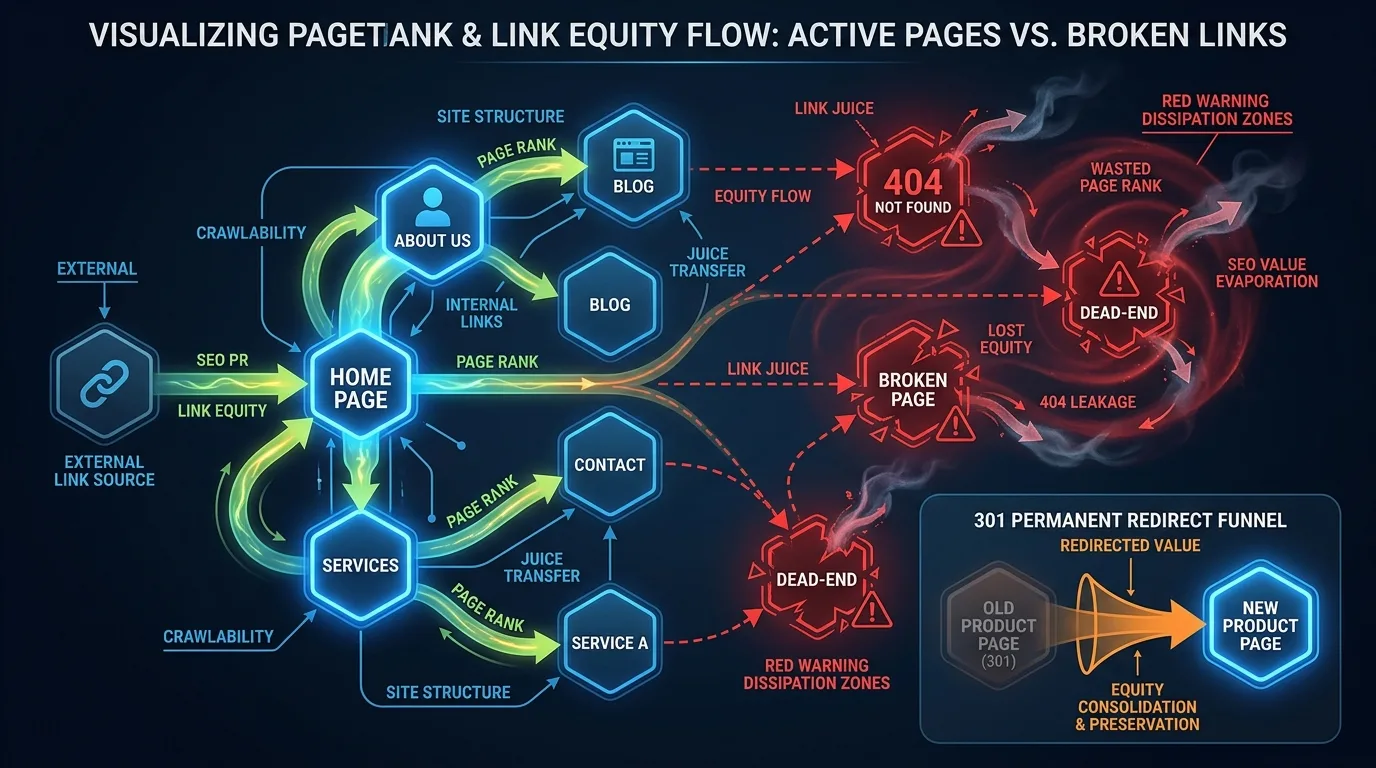
To examine how authoritative backlink acquisition supercharges this editorial engine, review our guide on the modern link building blueprint.
2. The Four Stages of the Modern B2B Search Journey: Beyond the Traditional Funnel
The classic linear marketing funnel (TOFU $ ightarrow$ MOFU $ ightarrow$ BOFU) no longer reflects how B2B purchasing decisions are made. Modern enterprise buying committees comprise an average of 6 to 11 stakeholders—including engineers, security officers, financial analysts, and C-suite sponsors—each conducting autonomous research across distinct digital channels.
To capture and influence these committees, content marketing must address four interconnected psychological phases:
| Journey Stage | Buyer Psychological State | Target Search Query Patterns | Optimal Content Architecture | Primary Conversion KPI |
|---|---|---|---|---|
| 1. Problem Unconscious to Conscious | Experiencing operational friction; seeking to name and diagnose the bottleneck. | "why is our database latency spiking", "how to reduce cloud egress costs" | Technical root-cause diagnostic guides, debugging frameworks, diagnostic calculators. | Bookmark rate, newsletter opt-in, technical doc view. |
| 2. Category & Solution Exploration | Understands the problem; evaluating architectural categories and operational models. | "headless cms vs decoupled cms", "self-hosted vs managed vector db" | Architectural comparison guides, technical whitepapers, framework decision trees. | Whitepaper download, interactive sandbox engagement. |
| 3. Vendor Comparison & Validation | Shortlisting specific vendors; seeking hard feature, compliance, and pricing comparisons. | "datadog vs dynatrace enterprise", "snowflake pricing per credit" | Transparent alternative pages, feature matrices, total cost of ownership (TCO) models. | Demo request, self-serve free trial signup, pricing sheet view. |
| 4. Risk Mitigation & Implementation | Selected preferred vendor; seeking proof of security, scalability, and ease of migration. | "how to migrate from magento to shopify", "soc2 compliance verification" | Step-by-step migration blueprints, enterprise security dossiers, reference architectures. | Executive sales meeting, procurement security sign-off. |
A complete editorial calendar must balance all four stages. While stage 1 builds long-term brand awareness, stages 3 and 4 capture buyers with active budgets ready to purchase today.
3. Architecting Scalable Topic Clusters: Pillar Pages, Supporting Hubs, and Spoke Interlinking
Modern search engines do not evaluate individual articles in isolation; they evaluate your Topical Authority across entire conceptual domains. If you publish a brilliant guide on "Enterprise Microservices" on a domain that has never published another article about software architecture, Google's algorithms have no contextual basis to trust your expertise.
The Hub-and-Spoke Architecture
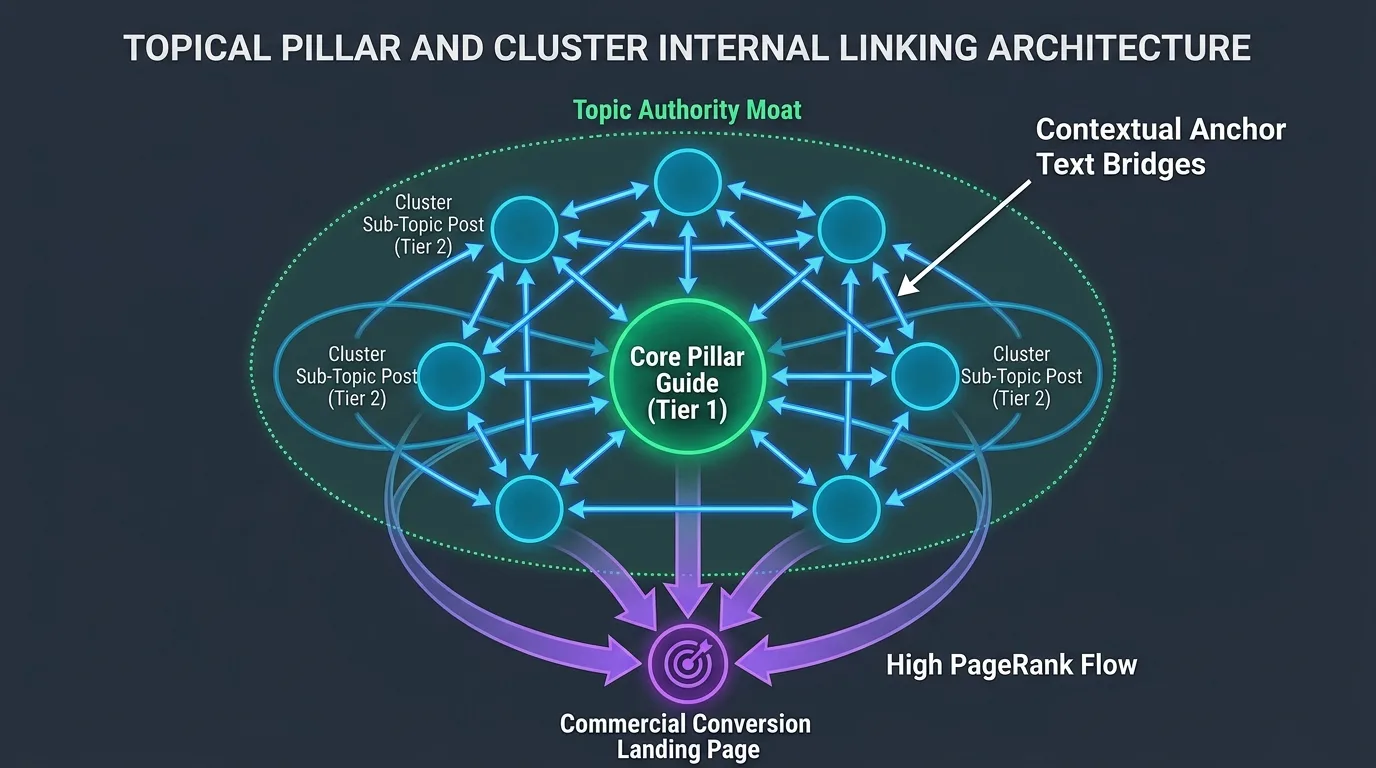
To establish undeniable topical authority, organize your editorial production into structured Topic Clusters:
- The Pillar Page (The Hub): A definitive, 4,000+ word master guide that provides a comprehensive overview of an entire core subject (e.g., The Complete Guide to Technical SEO). The pillar touches upon every sub-topic within the domain and acts as the central authoritative anchor.
- The Cluster Articles (The Spokes): Deep, granular 2,500+ word articles dissecting specific sub-components of the pillar (e.g., Crawl Budget Optimization, Log File Analysis, Faceted Navigation, Core Web Vitals).
- Rigorous Bidirectional Hyperlinking: Every spoke article links back to the central pillar using descriptive anchor text, and the pillar links down to every spoke. Crucially, spoke articles link laterally to sibling spokes within the same cluster.
This closed semantic loop signals to Google that your domain possesses exhaustive, end-to-end depth on the subject. When one article in the cluster gains backlinks and rankings, the accumulated PageRank flows through the internal links to lift the rankings of every related article in the cluster.
For more architectural principles on organizing semantic hierarchies, review our master guide on on-page SEO mastery and semantic structure.
4. The Anatomy of a High-Converting Enterprise Blog Post: Hook, Tension, Proof, and CTA
Why do most corporate blog posts fail to convert readers into leads? Because they are written like generic academic encyclopedias rather than persuasive commercial narratives. A high-converting enterprise article must follow a rigorous structural anatomy.
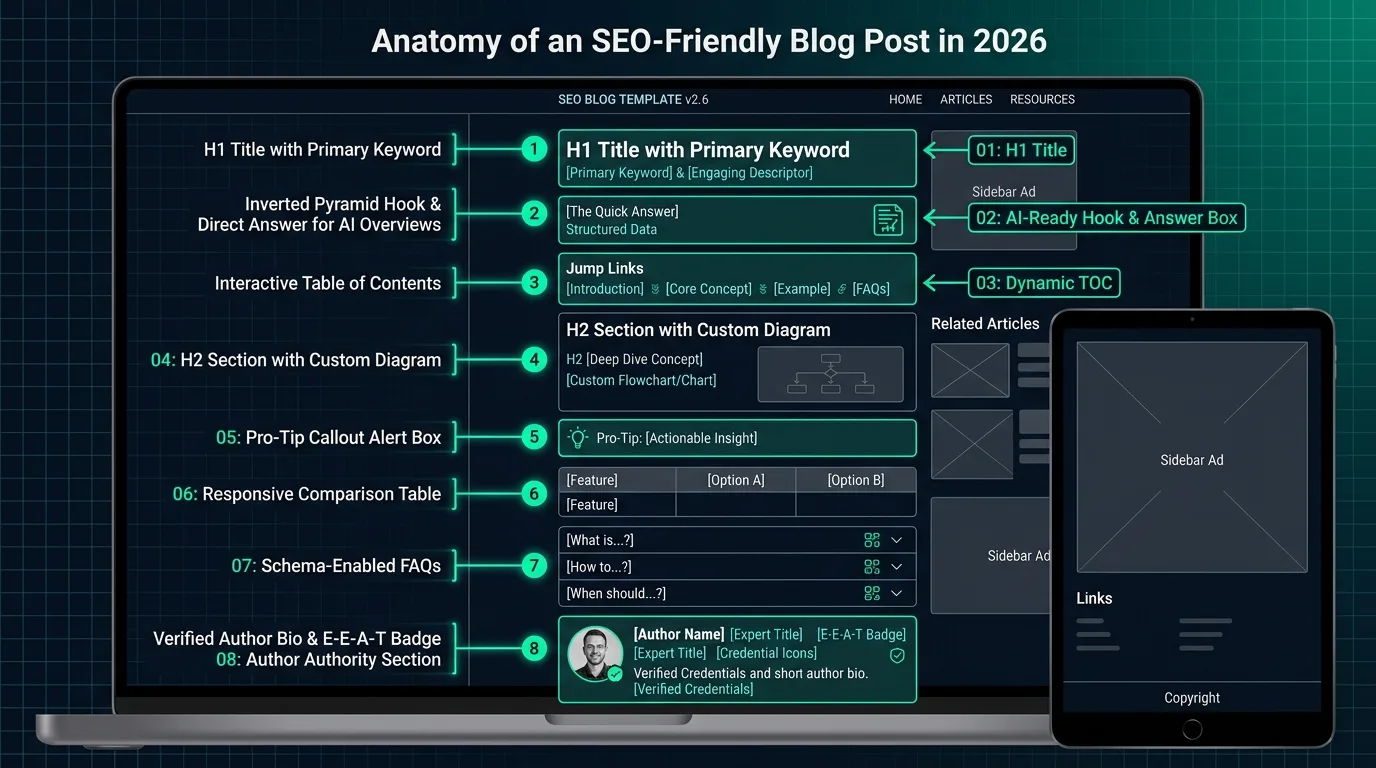
The 6 Essential Anatomical Components
- The Gripping Narrative Hook (First 100 Words): Validate the reader's acute frustration immediately. State the commercial stakes involved, avoid cliché dictionary definitions, and summarize the key strategic takeaway in a highlighted alert box.
- The Unspoken Industry Tension: Articulate the counter-intuitive reality or systemic breakdown that traditional solutions ignore. Create narrative tension that compels the reader to continue.
- Empirical Factual Proof: Ground your assertions in verifiable evidence: statistical tables, custom dark-mode architecture diagrams, and benchmark data. As explored in our deep dive into E-E-A-T mastery, empirical evidence establishes instant authority.
- Actionable Implementation Frameworks: Provide concrete, step-by-step instructions, complete code samples, or terminal configurations that the reader can execute immediately.
- Contextual Product Integration: Seamlessly demonstrate how your product or service operationalizes the solution. The product should appear not as an intrusive commercial pitch, but as the natural, friction-free tool for solving the problem explored in the text.
- The Value-Add Conversion Anchor: Conclude with a relevant, high-utility lead asset: a downloadable audit spreadsheet, an interactive configuration generator, or an invitation to an architecture review with a senior engineer.
5. The Editorial Production Machine: Sourcing Subject Matter Experts and Operationalizing Workflows
The single greatest operational challenge facing content marketing leaders is producing authentic, highly technical content at consistent scale. Generalist copywriters cannot write authoritative articles on Kubernetes container orchestration or SOC2 compliance frameworks without sounding superficial.
The solution is the SME Extraction Model (Subject Matter Expert Extraction):
The 4-Step SME Extraction Workflow
- The 30-Minute SME Interview: Rather than asking a busy senior engineer or product manager to write a 3,000-word draft, schedule a focused 30-minute recorded interview. Ask probing questions about edge cases, architectural trade-offs, and recent customer troubleshooting wins.
- AI Transcription & Factual Outline Extraction: Transcribe the audio recording using AI transcription tools. Extract the expert's raw insights, technical vocabulary, and real-world anecdotes into a structured editorial outline.
- Professional Ghostwriting & SEO Structuring: A skilled technical writer crafts the comprehensive article around the SME's actual words and mental models, integrating target keyword entities, headings, and schema markup.
- SME Sign-Off & Verification Gate: The expert conducts a rapid 10-minute technical review to verify that code snippets, architectural assertions, and technical claims are 100% accurate before publication.
This workflow enables high-velocity publication of genuine expert content without consuming valuable engineering sprint hours.
6. The Multi-Channel Content Repurposing Engine: 1 Pillar to 10 Micro-Assets
Publishing an extraordinary 4,000-word pillar guide and simply waiting for Googlebot to index it is a recipe for underperformance. To maximize content ROI, every flagship asset must serve as the raw material for a comprehensive Multi-Channel Repurposing Engine.
The 1-to-10 Repurposing Playbook
From a single validated pillar article, your team should automatically generate:
- 1 In-Depth Technical Newsletter: Extracting the contrarian industry take and delivering it directly to your executive email subscriber list.
- 5 Native LinkedIn Carousel Slides / Text Threads: Slicing the article's data tables and custom diagrams into bite-sized executive takeaways that drive high-engagement social commentary.
- 1 YouTube Video / Technical Screencast: Walking through the practical implementation code or architectural diagram in a 10-minute walkthrough.
- 2 Short-Form Social Video Clips: Highlighting the single most controversial or surprising finding for distribution on TikTok, YouTube Shorts, and LinkedIn.
- 1 Downloadable PDF Cheatsheet / Reference Architecture: Gated or ungated asset providing high-utility desktop reference value for practitioners.
This multi-channel distribution drives immediate referral traffic, builds executive social authority, and signals to Google's entity algorithms that your brand is a recognized topic authority across the broader web.
7. Integrating First-Party Data and Thought Leadership: Escaping the AI Commodity Trap
With generative AI tools capable of synthesizing commoditized summaries of any topic in seconds, publishing standard "how-to" articles is no longer a viable competitive strategy. To achieve durability in search rankings, your content must incorporate Ground-Truth Proprietary Data.
Proprietary data acts as an algorithmic shield. When your article introduces original empirical numbers—whether from internal product telemetry, anonymized customer benchmarks, or rigorous industry surveys—your content provides high Information Gain. AI answer engines like Gemini and Perplexity cannot synthesize your data from existing training corpora; they are forced to cite and link to your domain as the primary source. To master original survey design and PR backlink generation, explore our playbook on data-driven journalism and industry surveys.

8. Content Governance and Lifecycle Maintenance: Content Auditing, Refreshing, and Pruning
One of the most catastrophic mistakes in enterprise content marketing is treating content publication as a permanent "one-and-done" transaction. Over time, web content suffers from Content Decay: software libraries update, screenshots become obsolete, rankings slip, and search intent evolves.
Under Google's Helpful Content System, allowing hundreds of decaying, unhelpful articles to languish on your domain acts as an algorithmic anchor that suppresses your entire website. As detailed in our breakdown of recovering from Google's Helpful Content System, maintaining a pristine sitewide quality ratio requires continuous maintenance.

The Continuous Content Maintenance Protocol
- Quarterly Decay Audits: Identify URLs in Google Search Console experiencing year-over-year click declines exceeding 25%.
- The Annual Refresh Sprint: Overhaul core pillar articles every 12 months: update outdated statistics, replace deprecated code syntax, add new FAQ items, and verify all external citations.
- Decisive Pruning: Issue
HTTP 410 Goneheaders across obsolete event announcements, thin 300-word blog posts from 2018, and cannibalized content fragments that generate zero organic search demand.
9. Attribution and Pipeline Telemetry: Proving Content Marketing ROI to the C-Suite
To secure sustained budget and executive backing, content marketing leaders must articulate their financial return in the language of the C-suite: Pipeline Velocity, Customer Acquisition Cost (CAC), and Customer Lifetime Value (LTV).
Building the Content Attribution Architecture
Relying on standard last-click Google Analytics attribution severely undervalues content marketing, because buyers rarely discover a software platform via a blog post and immediately purchase a $50,000 annual contract on the spot. Enterprise organizations deploy a dual attribution model:
- First-Touch Organic Attribution: Credits the content asset that initially introduced the anonymous prospect to your brand ecosystem.
- Multi-Touch Opportunity Attribution: Analyzes every content asset consumed by stakeholders across an enterprise account between initial lead creation and closed-won opportunity status.
- Self-Reported Qualitative Attribution: Include an open-text form field on high-value demo forms asking: "How did you first hear about us?" Prospects frequently cite specific technical articles, newsletter deep dives, or podcast discussions that never appear in standard cookie-tracking logs.
When you present executive leadership with data demonstrating that accounts that engage with 3 or more editorial cluster articles close 45% faster with a 32% higher average contract value, content marketing ceases to be viewed as a cost center—it is recognized as the primary growth engine of the enterprise.
10. Frequently Asked Questions
Explore authoritative answers to common enterprise questions regarding content marketing strategy, editorial workflows, and organic revenue attribution.
How long does it take for a new content marketing engine to generate revenue?
While early leading indicators (keyword rankings, impressions, and newsletter subscribers) emerge within 60 to 90 days, consistent sales pipeline attribution typically requires 6 to 9 months of disciplined publishing. Enterprise B2B buying cycles are long; content assets must compound topical authority in Google's index before influencing multi-stakeholder purchasing decisions.
How many articles should an enterprise publish per month?
Quality and topical completeness vastly outweigh arbitrary publication volume. For most B2B enterprises, publishing 4 to 8 deeply researched, authoritative articles per month within a dedicated topic cluster generates far more revenue than churning out 30 superficial, commoditized posts.
What is the difference between a Pillar Page and a Cluster Spoke?
A Pillar Page is a broad, comprehensive master guide (3,500–5,000+ words) providing a high-level overview of an entire domain. A Cluster Spoke is a specialized, deep-dive article (2,000–3,000 words) focusing exclusively on a single sub-component of that domain. Spokes link up to the pillar, and the pillar links down to all spokes, establishing structured topical authority.
Should we gate our best content behind lead forms?
Generally, no. Gating your primary content blocks search engines from crawling and indexing your expertise, completely destroying organic search visibility. Keep all foundational guides, research benchmarks, and articles 100% ungated. Offer lightweight supplementary assets (such as editable templates, raw datasets, or interactive calculators) as optional value-add downloads.
How do we balance SEO requirements with authentic thought leadership?
They are not mutually exclusive; they reinforce each other. Use SEO keyword research to discover the exact vocabulary, questions, and pain points your target audience is searching for. Then, use authentic thought leadership, proprietary data, and real-world case studies to answer those questions with superior depth and nuance.
What role does AI play in a modern editorial engine?
AI should be deployed as an editorial research and acceleration assistant—transcribing SME interviews, generating initial structural outlines, proofreading grammar, and suggesting schema markup. AI should never be used to mass-generate unreviewed commodity text, which triggers Google's Helpful Content System penalties and alienates sophisticated readers.
How often should we update or refresh existing blog posts?
High-value commercial pillar pages and top-traffic articles should undergo an annual comprehensive audit and refresh. Review headings, update outdated statistics, add new FAQs, replace broken links, and verify that code examples align with the latest software releases.
How do we prevent keyword cannibalization across our blog?
Maintain an active Keyword Mapping Registry. Before drafting a new article, verify that no existing page on your domain already targets the primary search intent. If a related article exists, either update the existing post or angle the new article toward a distinctly different buyer persona or lifecycle stage.
What is Information Gain and why does it matter for content marketing?
Information Gain measures the amount of unique, incremental knowledge an article provides beyond what is already available on other top-ranking websites. Google's algorithms actively demote articles that merely paraphrase existing search results, while rewarding content featuring original data, first-hand case studies, and proprietary visuals.
How should we structure Call-to-Actions (CTAs) within technical articles?
Avoid generic, disruptive popups. Use contextual, text-based inline callouts that directly connect the problem discussed in the paragraph to your product's specific capability. Offer frictionless next steps—such as interactive product sandboxes, documentation links, or technical whitepapers—tailored to the reader's intent stage.



Ratings & reviews
No reviews yet. Be the first.