
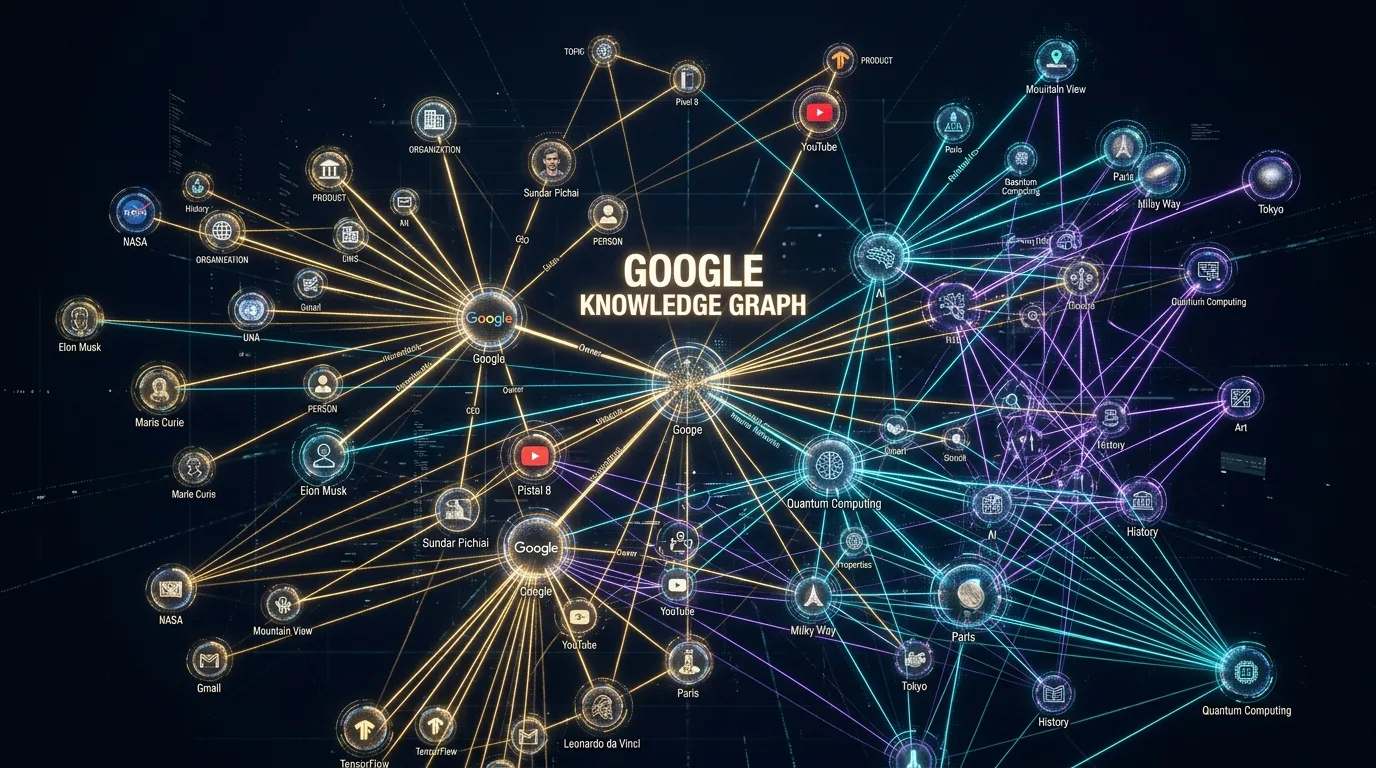
Modern search engines no longer evaluate content merely as bags of disjointed keywords. In 2012, Google declared its transition from "strings to things," fundamentally re-architecting indexation, query parsing, and ranking around interconnected, real-world concepts known as entities. Today, with the maturation of Google's Knowledge Graph, neural retrieval algorithms, and generative AI overviews, understanding semantic search is no longer an optional tactic—it is the foundational operating system of enterprise SEO. When you align your web properties with the graph-based ontology of search engines, you unlock predictable visibility, resilient Knowledge Panels, and prioritized inclusion in generative answer systems.
1. From Strings to Things: The Architectural Shift to Semantic Search
For the first fifteen years of web search, information retrieval was predominantly lexical. Search algorithms relied on inverted indices, term frequency-inverse document frequency (TF-IDF), and literal string matching between query tokens and indexed documents. This architectural limitation resulted in pervasive query ambiguity, keyword stuffing, and brittle rankings easily manipulated by exact-match phrases.
The introduction of the Knowledge Graph in 2012, followed by the Hummingbird algorithm in 2013 and transformer-based neural models (BERT, MUM, and Gemini), completely upended this paradigm. Rather than asking "Which document contains these exact characters?", modern search engines ask:
- What specific entities is the user inquiring about?
- What are the semantic predicates connecting these entities?
- Which documents in our corpus exhibit the highest topical authority, factual consensus, and attribute density regarding these entities?
To succeed under this framework, digital marketers and technical architects must stop optimizing for isolated keyword targets. Instead, we must architect web pages as nodes within a broader conceptual network. When search engines ingest your content, they pass the document through advanced Natural Language Processing (NLP) pipelines that identify named entities, map semantic triples, and reconcile claims against trusted knowledge repositories. Aligning your content with standard comprehensive on-page SEO frameworks ensures both human readers and autonomous machine crawlers parse your core concepts without friction.
2. How Google's Knowledge Graph Constructs and Stores Entities
At its core, Google's Knowledge Graph is a massive, multi-relational semantic graph database. In mathematical terms, it can be modeled as a directed graph where nodes represent entities and edges represent relationships (predicates) between those entities. Each distinct entity is assigned a persistent, unique identifier—historically known as a Freebase ID (e.g., /m/045c7b) and modernly mapped to Google Knowledge Graph IDs (e.g., kg:/m/045c7b or kg:/g/11b6w3y_8s) and Wikidata Q-identifiers.
The construction of this knowledge repository is not static; it is a continuous, dynamic process governed by Google's Knowledge Vault. The Knowledge Vault autonomously fuses factual data extracted from structured sources (such as Wikipedia, Wikidata, and CIA World Factbook) with probabilistic triples extracted directly from billions of unstructured web pages. Each extracted fact is assigned a probabilistic confidence score based on the reliability of the source, corroborating citations across independent domains, and absence of contradictory signals.
<Subject> <Predicate> <Object>. For example, <Google> <foundedBy> <Larry Page> and <Google> <headquarteredIn> <Mountain View, California>. Your on-page copywriting must construct unambiguous syntactic sentences that allow NLP parsers to extract clean triples without semantic noise.The following architectural diagram illustrates how raw, unstructured web content is processed by neural NLP pipelines into formalized semantic triples and subsequently integrated into the multi-dimensional semantic knowledge graph.
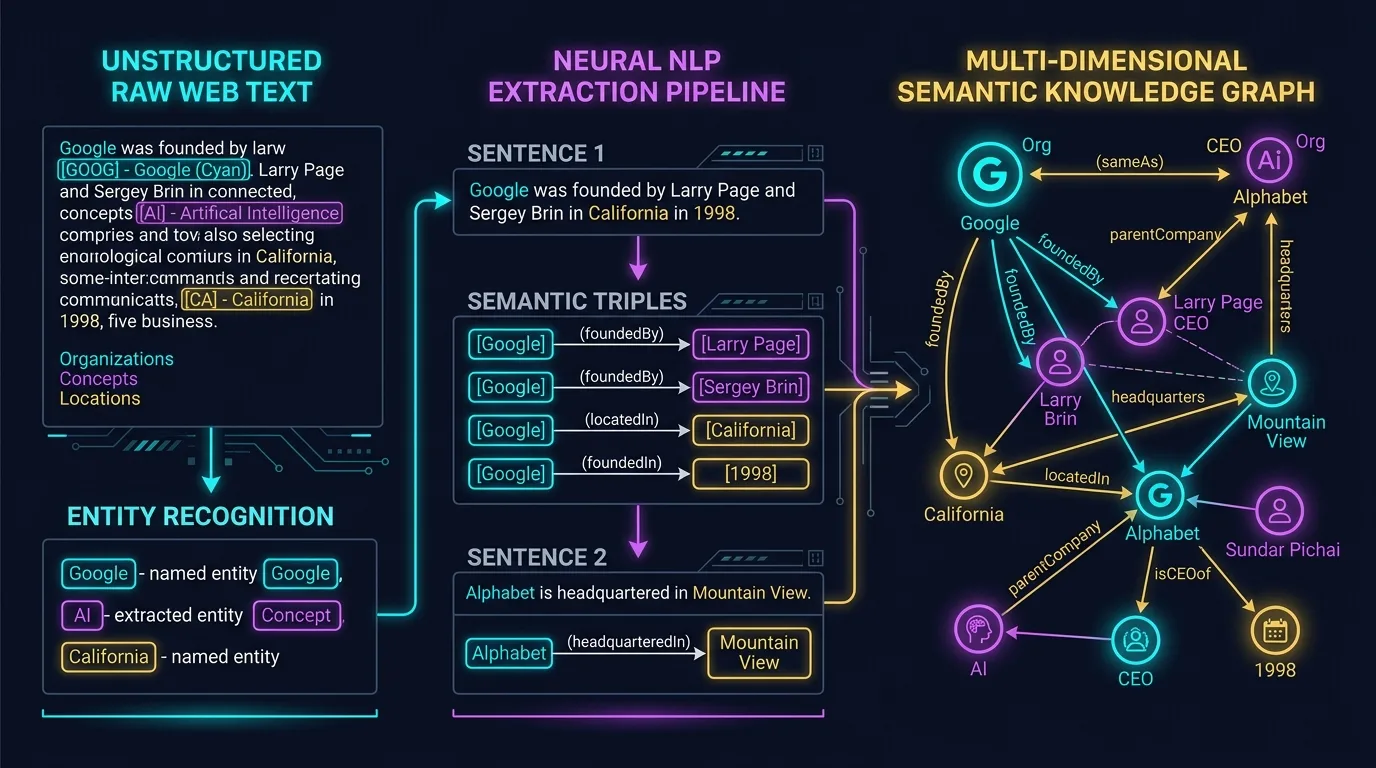
Figure 1: Neural NLP entity recognition and Subject-Predicate-Object triple extraction pipeline powering Google's Knowledge Graph.
3. Natural Language Processing (NLP), Named Entity Recognition (NER), and Triple Extraction
When Googlebot crawls an HTML document, the primary rendering and indexing engine extracts text content and executes Named Entity Recognition (NER) algorithms. NER systems categorize sequences of words into predefined classes: PERSON, ORGANIZATION, LOCATION, EVENT, PRODUCT, and CONCEPT.
Beyond simple identification, the algorithm calculates two critical metrics for every entity identified on a page:
- Entity Salience: A score ranging from 0.0 to 1.0 that quantifies the central importance of an entity to the document's overall topic. Salience is determined by syntactic position (appearance in H1, early lead paragraphs, title tags), frequency of co-occurring related concepts, and grammatical centrality in core sentences.
- Topical Co-occurrence (LSI & Word Embeddings): Google evaluates whether the primary entity is surrounded by its expected semantically related entities. For example, an article claiming to be an authoritative guide on "Kubernetes" that never mentions "Docker," "Pods," "Nodes," "Container Orchestration," or "etcd" exhibits low semantic completeness and will struggle to establish topical authority.
To optimize for NER, technical writers should structure content using clear subject-verb-object grammar, avoid convoluted passive voice, and explicitly define relationship attributes. Rather than writing poetic, vague prose, author precise statements that state exact corporate parentage, founding years, headquarters locations, and standardized industry taxonomy.
4. Entity Disambiguation and the Role of Schema.org `sameAs` & Linked Open Data
One of the most complex challenges facing search engines is entity disambiguation. If a web page mentions "Michael Jordan," is it referring to the legendary Chicago Bulls basketball player, or the world-renowned UC Berkeley computer science professor and machine learning pioneer? If a site discusses "Apple," is it analyzing consumer technology hardware or pomology and agricultural trade?
Search engines resolve ambiguity through contextual entity clusters and explicit machine-readable linked data. By implementing connected enterprise schema markup, webmasters can definitively link their proprietary entities to globally established authorities in the Linked Open Data cloud.
The most powerful schema property for achieving unambiguous entity reconciliation is sameAs. By pointing your Organization or Person schema to verified external identifiers—such as Wikidata Q-items, Wikipedia articles, official LinkedIn profiles, and Crunchbase entries—you provide mathematical certainty to Google's Knowledge Vault.
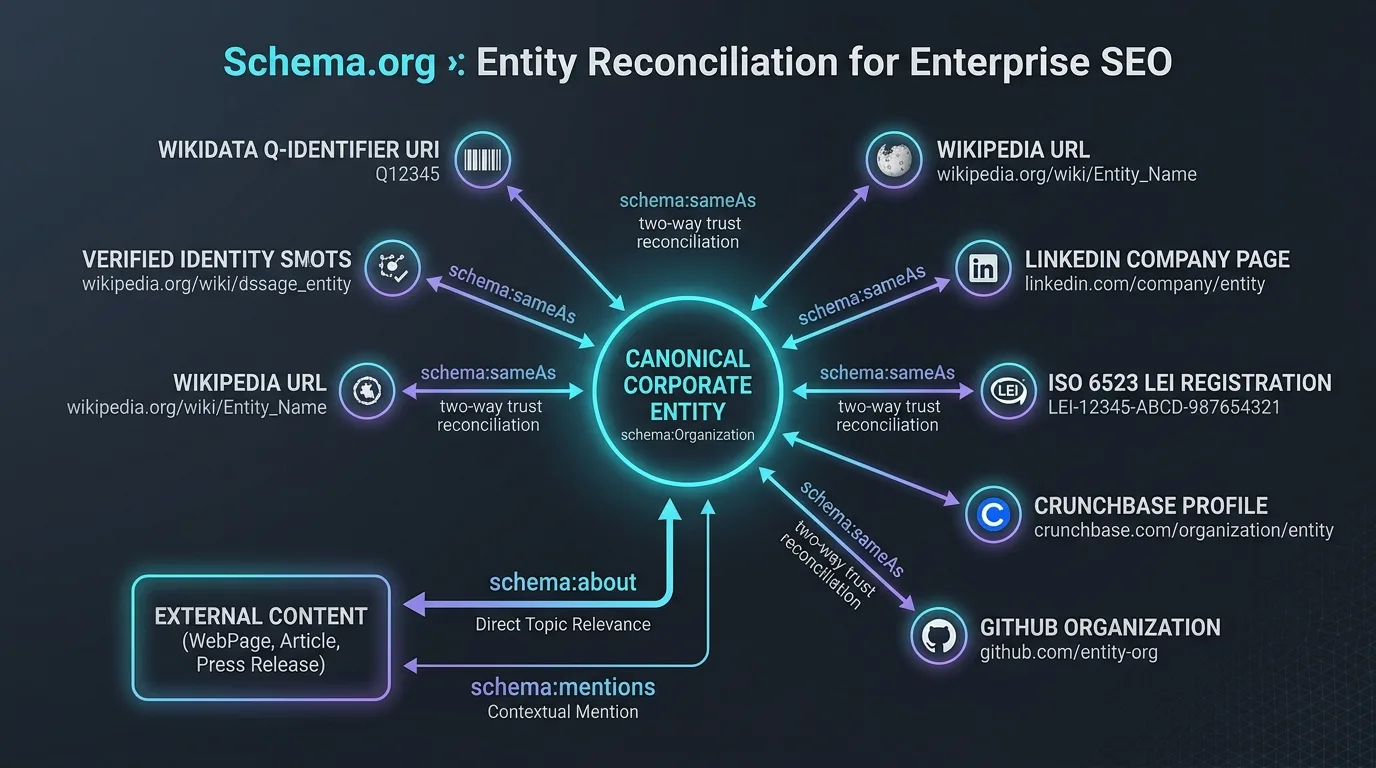
Figure 2: Schema.org sameAs and about/mentions radial topology for enterprise entity reconciliation and identity verification.
Consider the following production-grade JSON-LD snippet illustrating how an enterprise organization establishes verified entity nodes using sameAs, knowsAbout, and about properties:
{
  "@context": "https://schema.org",
  "@graph": [
    {
      "@type": "Organization",
      "@id": "https://seobeen.com/#organization",
      "name": "Seobeen",
      "url": "https://seobeen.com",
      "logo": "https://seobeen.com/assets/logo.png",
      "sameAs": [
        "https://www.wikidata.org/wiki/Q1122334455",
        "https://www.crunchbase.com/organization/seobeen",
        "https://www.linkedin.com/company/seobeen",
        "https://twitter.com/seobeen"
      ],
      "knowsAbout": [
        "https://www.wikidata.org/wiki/Q180711",
        "https://www.wikidata.org/wiki/Q79764",
        "https://www.wikidata.org/wiki/Q11660"
      ]
    },
    {
      "@type": "WebPage",
      "@id": "https://seobeen.com/blog/semantic-search-knowledge-graph-seo-handbook-entities#webpage",
      "url": "https://seobeen.com/blog/semantic-search-knowledge-graph-seo-handbook-entities",
      "name": "The Semantic Search and Knowledge Graph SEO Handbook: Structuring Web Entities for Google",
      "isPartOf": { "@id": "https://seobeen.com/#website" },
      "about": [
        {
          "@type": "Thing",
          "name": "Semantic Search",
          "sameAs": "https://en.wikipedia.org/wiki/Semantic_search"
        },
        {
          "@type": "Thing",
          "name": "Google Knowledge Graph",
          "sameAs": "https://en.wikipedia.org/wiki/Google_Knowledge_Graph"
        }
      ]
    }
  ]
}
This explicit linked data approach eliminates ambiguity and instructs Googlebot to associate your domain directly with the high-confidence entities already cataloged in Google's Knowledge Vault.
5. Topical Maps, Hub-and-Spoke Silos, and Semantic Internal Linking
Search engines do not evaluate individual pages in isolation. They evaluate an entire web property's topological coverage of an entity's conceptual domain. If your website attempts to rank for an enterprise-level topic with only one or two isolated articles, Google's algorithms will determine that your site lacks the required topical authority depth to satisfy diverse search intents.
The enterprise solution to this challenge is the construction of a comprehensive Topical Map. A topical map decomposes a broad primary entity into an exhaustive hierarchy of sub-topics, attribute variations, practical applications, and related entities. This taxonomy is then manifested physically on your website through a strict hub-and-spoke internal linking architecture.
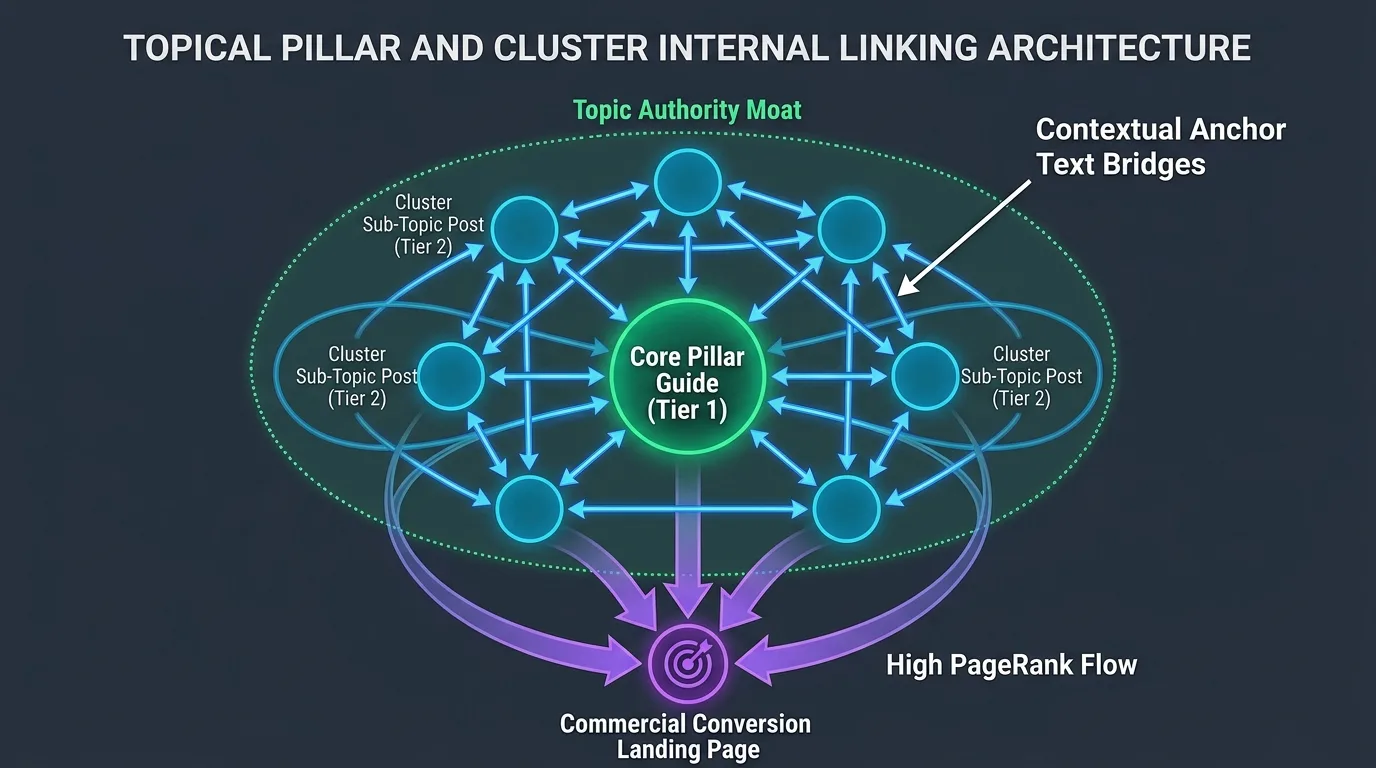
Figure 3: Multi-tier topical pillar and cluster architecture creating a robust entity authority moat and channeling PageRank.
Notice the structural discipline illustrated above. In an enterprise semantic hub-and-spoke model:
- Tier 1 Core Pillar: Targets the root parent entity with exhaustive depth (3,000+ words). It introduces every major sub-entity and provides high-level conceptual frameworks.
- Tier 2 Cluster Articles: Drill down into specific child entities, technical workflows, or operational execution guides. Each Tier 2 article maintains bidirectional internal links back to the Tier 1 Pillar using exact, descriptive entity anchor text.
- Contextual Anchor Bridges: Related cluster articles link horizontally to one another only when their respective entities share direct semantic relationships in the knowledge graph. This prevents link equity dilution while maximizing context propagation.
When combined with systematic enterprise e-commerce taxonomy structures or programmatic landing page architectures, topical clusters prove to search engine crawlers that your domain possesses complete topical coverage.
6. Measuring Entity Salience, Relationship Confidence, and Knowledge Vault Metrics
To operationalize semantic SEO at scale, enterprise teams cannot rely on subjective intuition. We must leverage algorithmic measurement tools to evaluate entity coverage prior to and following publication. Google's Cloud Natural Language API provides an exact window into how Google's neural parsers interpret text.
The table below summarizes the key semantic metrics returned by Google's Natural Language Processing algorithms and how technical SEO architects must interpret them:
| NLP Metric | Technical Definition | Optimization Target | Strategic SEO Impact |
|---|---|---|---|
| Entity Salience | Normalized score (0.0 to 1.0) indicating importance of entity within document | > 0.35 for Primary Entity; 0.05–0.15 for Supporting Entities | Determines whether Google considers the article to be fundamentally about the target concept |
| Sentiment Score | Numerical polarity of text ranging from -1.0 (negative) to +1.0 (positive) | 0.0 to +0.4 (Neutral, Objective, Factual Tone) | Prevents subjective bias penalties, critical for YMYL compliance and factual indexation |
| Sentiment Magnitude | Total emotional volume expressed regardless of polarity (0.0 to +inf) | Low to Moderate (Factual clarity over hyperbolic rhetoric) | Ensures content aligns with encyclopedic knowledge standards favored by Google's Knowledge Vault |
| Entity Mentions Offset | Character byte positions showing where entities appear across the HTML tree | Primary entity in first 100 words, H1, and conclusion | Signals immediate document topic and reinforces semantic boundaries |
| Wikidata Q-ID Match | Automated mapping of text token to a verified Wikidata entity ID | 100% resolution for all primary and secondary entities | Enables instant knowledge graph node mapping without probabilistic ambiguity |
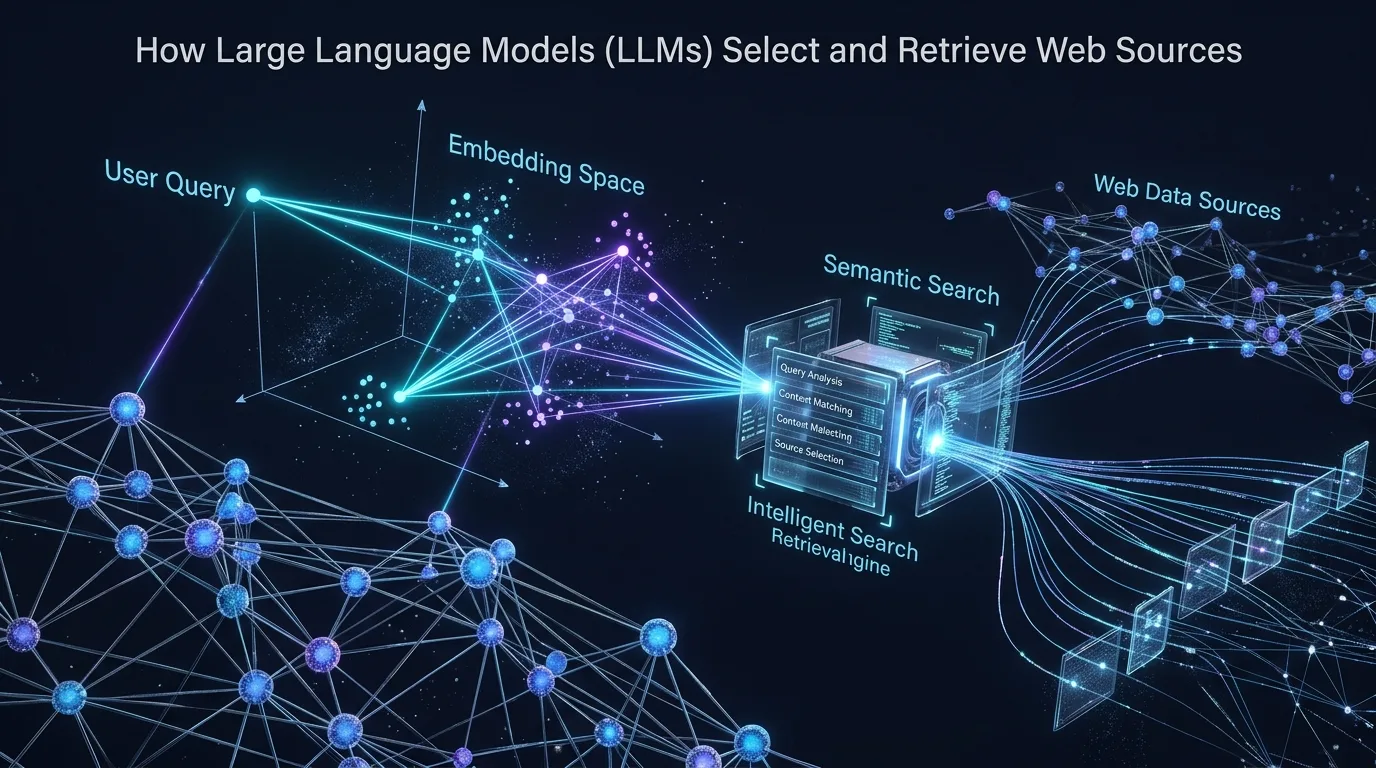
By auditing your content through automated Python pipelines utilizing Google's Cloud Natural Language API or open-source libraries like spaCy and Stanza, you can identify semantic gaps where critical co-occurring entities were omitted. Furthermore, comparing your entity graph against pages performing well in LLM source selection and semantic vector retrieval ensures that your digital assets remain prominently cited in both traditional SERPs and AI answers.
7. Google Knowledge Panels: Signals, Reconciliation, Claiming, and Entity Home
A Google Knowledge Panel is the ultimate visual proof of entity recognition. When Google is mathematically confident about the identity, attributes, and societal significance of a brand or individual, it generates a dedicated Knowledge Panel on the right rail of desktop SERPs and top of mobile results.
Securing and controlling a Knowledge Panel requires understanding the reconciliation pipeline used by Google's Knowledge Vault. Google does not trust any single website—not even your own official corporate domain. Instead, it aggregates cross-verifiable data points across multiple high-authority trust anchors.
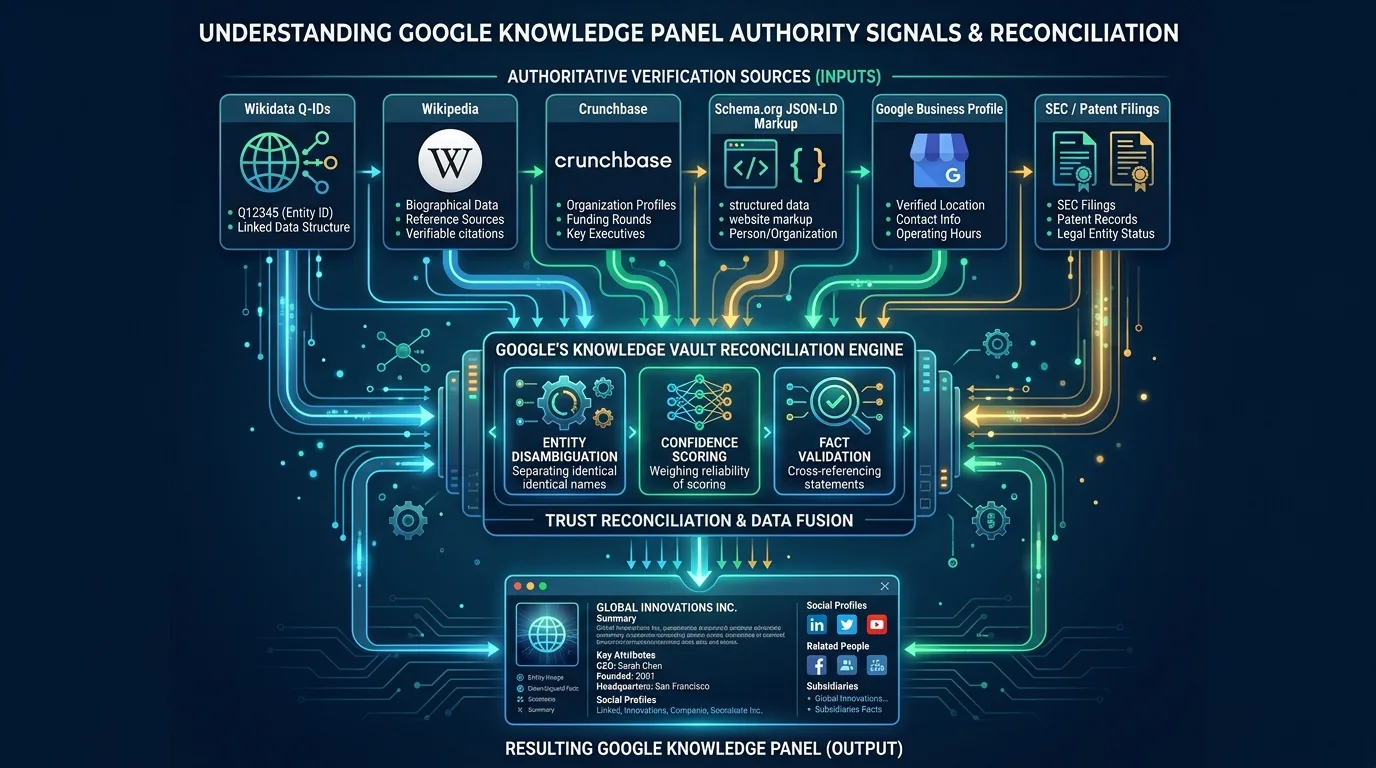
Figure 4: Google's Knowledge Vault reconciliation engine synthesizes multi-source inputs into verified Knowledge Panels.
To construct a bulletproof Knowledge Panel for your organization or executives, execute the following systematic six-step entity reconciliation protocol:
- Establish the Canonical Entity Home: Designate a single authoritative page on your domain (typically the
/aboutpage or an executive bio page) as the definitive Entity Home. This page must contain comprehensive corporate history, registration numbers, leadership bios, and official contact information. - Embed Complete Schema.org Organization Markup: Structure the Entity Home with rich JSON-LD markup incorporating
legalName,foundingDate,founders,taxID,duns, and comprehensivesameAslinks. - Create and Maintain a Wikidata Item: Wikidata is the single most influential third-party database queried by Google's Knowledge Graph. Create an objective, properly sourced Wikidata item with statements connecting to your official website, social profiles, and industry identifiers.
- Align Corporate Profiles Across Authoritative Registries: Ensure strict 100% consistency across Crunchbase, LinkedIn, Bloomberg, PitchBook, and industry associations. Factual discrepancies in founding dates or executive titles cause reconciliation confidence scores to drop precipitously.
- Earn Authoritative Third-Party Mentions: Tier-1 journalistic coverage, government registry listings, and verified patent databases provide unassailable corroborate citations for the Knowledge Vault.
- Claim the Knowledge Panel: Once Google generates the panel, click "Claim this knowledge panel" and verify ownership through your authenticated Google Search Console profile.
8. Content Optimization for Semantic Search: Beyond Keywords to Entity Ecosystems
How do we translate semantic search theory into daily editorial and technical copywriting workflows? Transitioning an editorial team from legacy keyword stuffing to entity ecosystem optimization requires a fundamental shift in research and drafting methodologies.
Below is a comparative breakdown illustrating the operational differences between legacy keyword optimization and modern semantic entity architecture:
| Dimension | Legacy Keyword-Based SEO | Modern Semantic Entity SEO |
|---|---|---|
| Core Focus | Exact string repetition, keyword density percentage, and meta keyword matching | Real-world concepts, relationship triples, and topical completeness |
| Content Architecture | Multiple repetitive thin pages targeting slight keyword variants (e.g., "best crm", "top crm") | Comprehensive pillar pages and modular cluster spokes structured around entity ontologies |
| Schema Implementation | Basic standalone markup often disconnected from site-wide identity | Fully connected @graph JSON-LD with unambiguous sameAs, about, and mentions URIs |
| Internal Linking | Generic anchor text or aggressive exact-match keyword anchors without topical grouping | Contextual anchor bridges connecting parent, child, and sibling entities along semantic paths |
| AI / LLM Search Readiness | Low; vulnerable to being summarized without attribution or bypassed entirely | High; high entity density and factual information gain make content the ideal RAG citation source |
| Measurement Paradigm | Rankings for discrete keyword buckets in standard rank tracking tools | Knowledge Graph inclusion, Entity Salience scores, and semantic vector visibility in AI search |
When preparing an editorial brief, follow this practical checklist:
- Identify the Primary Entity (the central node) and its unique Wikidata identifier.
- Identify 5–10 Essential Secondary Entities that must be discussed to satisfy topical completeness.
- Draft clear syntactic sentences defining relationships between primary and secondary entities.
- Incorporate interactive, authoritative data tables and structured visual assets that provide genuine information gain.
- Audit the published URL to ensure standard technical crawl diagnostics verify zero indexation blockers or schema validation errors.
9. Enterprise Case Study: Building an Omnichannel Entity Footprint that Dominates SERPs
To demonstrate the real-world power of semantic entity architecture, consider the transformation of Novatech Solutions (name anonymized for confidentiality), a high-growth B2B enterprise software provider. Despite investing over $150,000 monthly in content production, the company experienced a 35% decline in organic traffic following successive core algorithm updates.
The enterprise engineering team executed a six-month semantic overhaul consisting of three coordinated phases:
- Entity Consolidation & Content Pruning: The 800 thin articles were consolidated into 42 comprehensive, authoritative entity pillar hubs. Cannibalizing pages were 301-redirected to the designated parent pillar, preserving accumulated link equity while concentrating topical authority.
- Knowledge Graph Reconciliation: A verified Wikidata item was created with comprehensive external references. The corporate
/aboutpage was re-engineered as the canonical Entity Home, equipped with multi-entity JSON-LD graphs linking to Wikidata, LinkedIn, Crunchbase, and GitHub. - Semantic Hub-and-Spoke Internal Linking: Every cluster spoke was re-linked using exact entity relationship anchors, mirroring the company's multi-layered product ontology. In addition, the site was prepared for emerging multimodal AI search strategies by integrating rich technical diagrams and schema-verified visual media.
The results were transformative. Within 120 days of deployment, Google awarded Novatech a fully verified corporate Knowledge Panel. Organic traffic surged by 184% year-over-year, and the company's pillar pages achieved top-3 rankings for over 450 highly competitive enterprise commercial queries. Furthermore, Novatech emerged as the primary cited authority in over 60% of generative AI search summaries across their niche.
10. Frequently Asked Questions (FAQ)
Below are authoritative answers to the most critical strategic and technical questions regarding semantic search, entity SEO, and Google's Knowledge Graph.


Ratings & reviews
No reviews yet. Be the first.