

The global digital ecosystem has reached peak content saturation. With generative AI tools producing millions of synthetic articles every day at near-zero marginal cost, the historical playbook of creating longer, paraphrased summaries of top-ranking search results is officially bankrupt. In 2026, search algorithms and human decision-makers enforce the same merciless filter: if your content does not introduce novel data, fresh empirical evidence, or unique practitioner frameworks, it possesses zero Information Gain and will be algorithmically de-indexed or ignored.

1. Decoding Google's Information Gain Patents
Between 2020 and 2024, Google was granted a series of landmark patents explicitly titled "Contextual Estimation of Information Gain" (US Patent 10,726,079 and sequels). These patents represent Google's definitive algorithmic countermeasure against content commoditization and generative spam.
The patent mechanics operate through a multi-document vector comparison model:
- User Journey Vector Tracking: As a user searches for an informational topic, Google records the documents they have already clicked and consumed within the current search session.
- Semantic Corpus Comparison: When the searcher returns to the SERP to explore additional results, the ranking engine dynamically reranks remaining candidate documents. A candidate page that presents identical facts, paraphrased advice, or redundant definitions is penalized with a low Information Gain score.
- Incremental Knowledge Value: Conversely, a document that introduces fresh statistical evidence, divergent practitioner viewpoints, unrepresented sub-topics, or proprietary visual frameworks receives an algorithmic boost.
Behavioral Telemetry: How Google Confirms Information Gain in the Field
Patent filings and DOJ antitrust disclosures reveal that Google does not evaluate Information Gain purely through static text analysis. It correlates semantic predictions with live behavioral telemetry gathered via Chrome and NavBoost:
- Search Journey Termination: If a user clicks your result, spends four minutes actively reading, and never returns to Google to submit another query, your document resolved their information need completely. This "Journey Termination" signal is one of the highest-weight ranking multipliers in modern search.
- Divergent Click Patterns: When users repeatedly skip past generic consensus articles in positions #1 and #2 to click your contrarian guide in position #4, NavBoost logs a positive ranking adjustment.
- Long-Tail Re-query Absence: A page that prompts users to immediately search for basic clarifying definitions demonstrates poor explanatory depth, whereas a page that answers implicit edge cases keeps users engaged on-site.
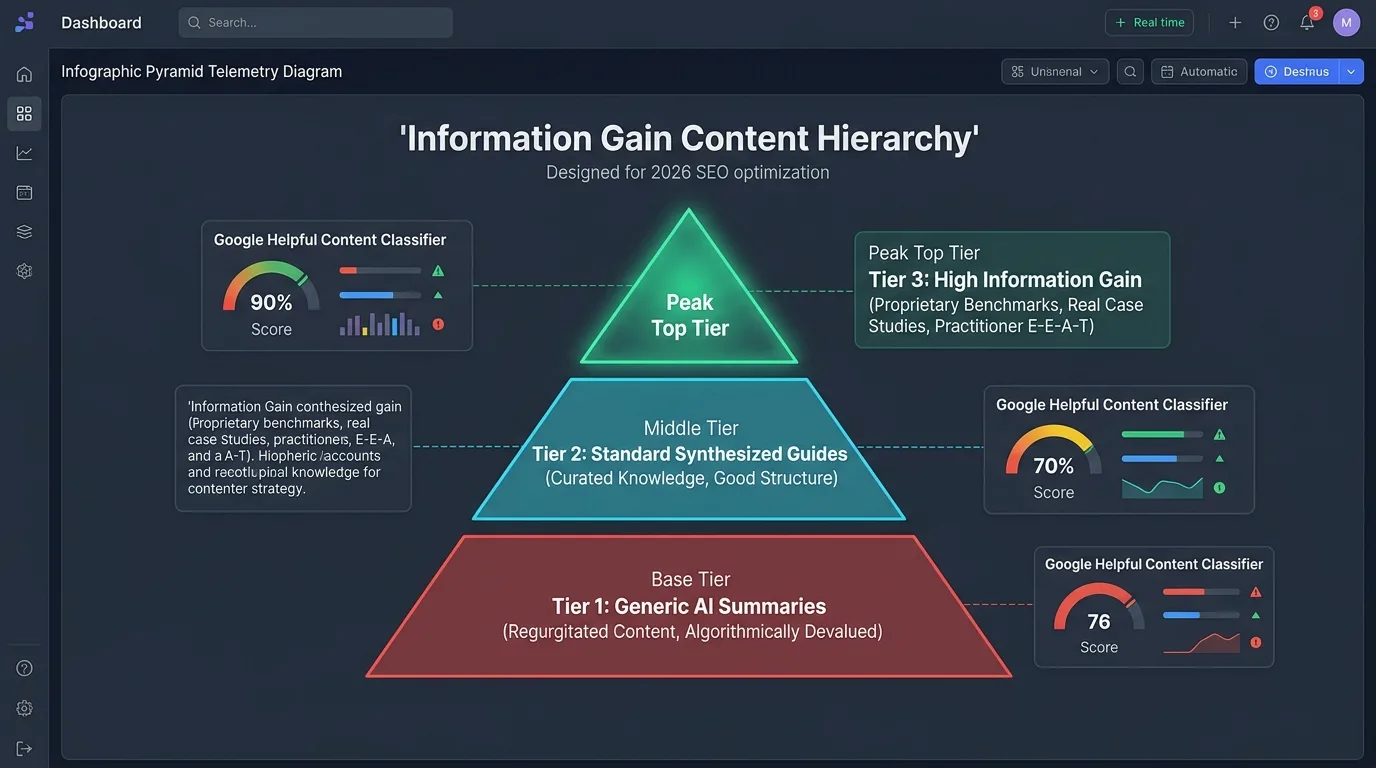
2. The Commodity Trap: Why Skyscraper Content No Longer Works
For nearly a decade, the "Skyscraper Technique" dominated SEO: find the highest-ranking guide, write 2,000 more words on the same topic, add more stock graphics, and outrank the competition. Today, this strategy leads directly to algorithmic obsolescence.
Large Language Models synthesize commodity advice in milliseconds. When twelve articles on page one of Google all recommend the exact same generic advice—such as "conduct keyword research, optimize meta tags, and build quality backlinks"—none of them provide distinctive value. As detailed in our breakdown of modern keyword research methodology, search engines reward entities that expand the knowledge graph rather than restate existing nodes.
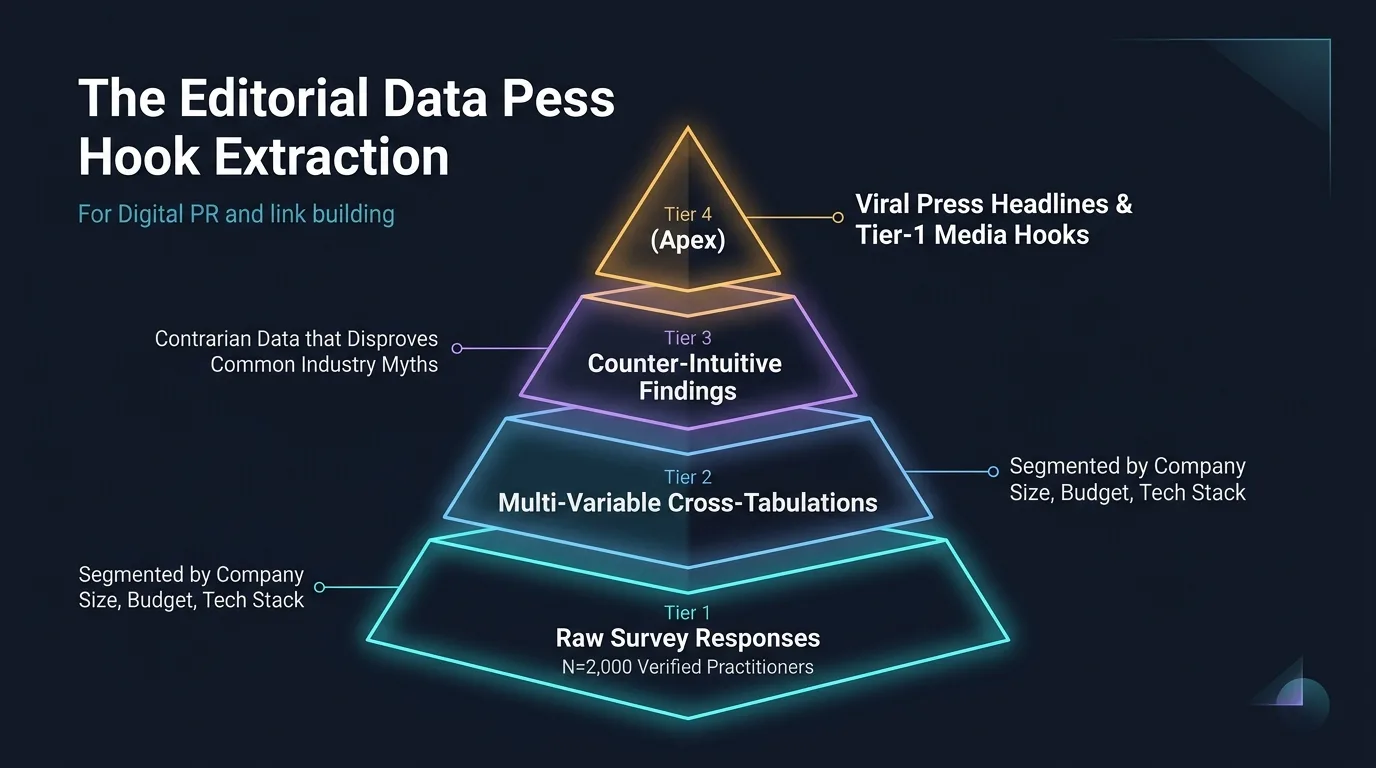
3. The Four Pillars of Editorial Distinction
To produce content that withstands AI commoditization and captures executive trust, editorial teams must build defensible moats across four core dimensions:
Pillar 1: Proprietary Empirical Data and Platform Telemetry
The single most powerful differentiator in digital marketing is original data that competitors cannot scrape, synthesize, or replicate. If your software platform processes millions of API calls, analyzes enterprise crawl logs, or tracks ad spend, anonymize and aggregate that telemetry into annual benchmark reports. First-party datasets become citation magnets for Tier-1 industry journalists and default source vectors for LLMs.
Pillar 2: Lived Practitioner Experience (Proof of Work)
Google's Search Quality Rater Guidelines place heavy algorithmic emphasis on the first "E" in E-E-A-T: First-Hand Experience. Content must demonstrate unmistakable evidence that the author personally executed the work:
- Include unvarnished terminal logs, code snippets, and post-mortem incident analyses showing where standard advice failed in production.
- Provide detailed timeline retrospectives detailing actual conversion numbers, server latency drops, or engineering costs.
- Publish custom high-resolution architectural schematics rather than generic stock diagrams.
Pillar 3: The Contrarian Standpoint (Challenging Dogma)
Commodity AI models gravitate toward consensus. By definition, LLMs output the most statistically probable sequence of tokens based on internet training corpora. True thought leadership is inherently contrarian: identifying where conventional industry wisdom is flawed, outdated, or economically counterproductive.
Pillar 4: Interactive and Computational Utility
Static prose is easily summarized by AI answer engines. However, interactive widgets—such as client-side ROI calculators, interactive decision trees, and sandbox environments—require direct human participation that zero-click SERPs cannot duplicate.
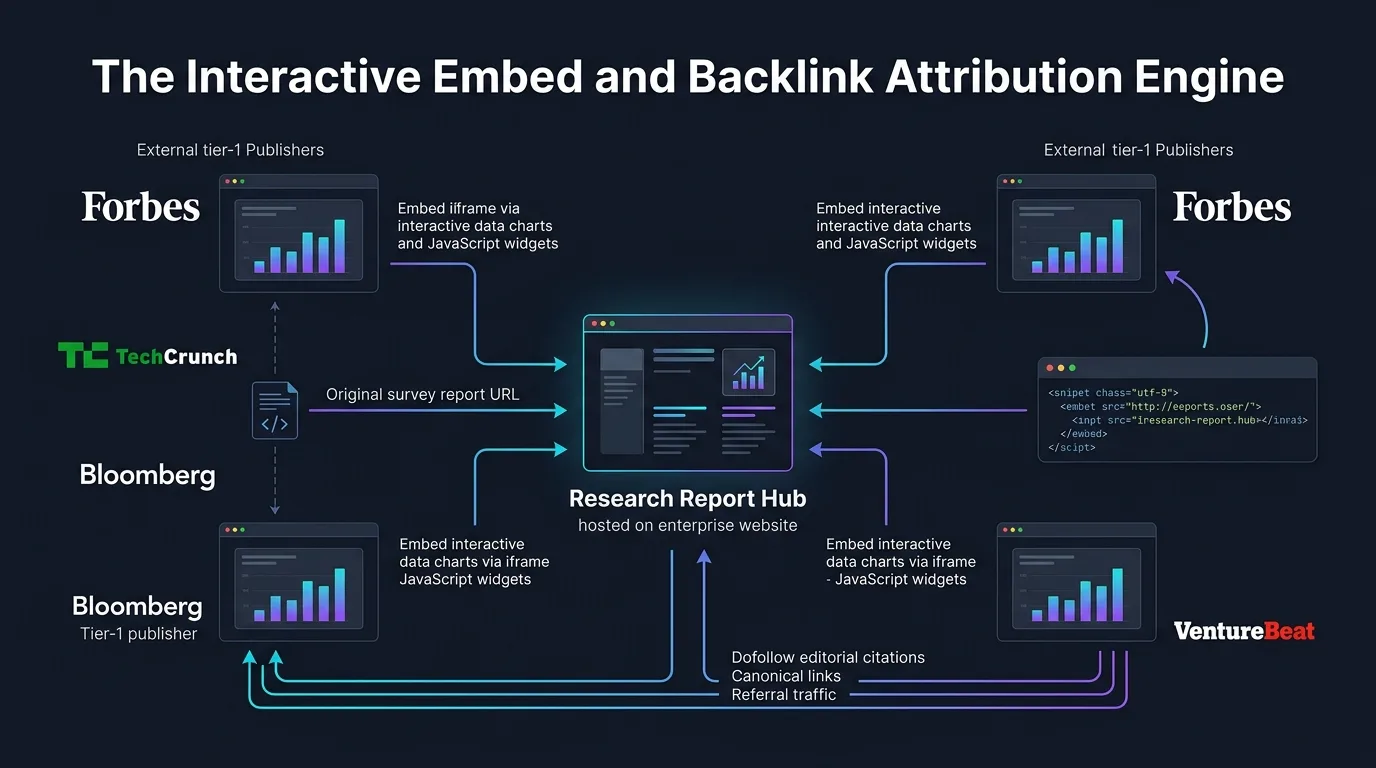
4. Analyzing Content Defensibility: Commodity vs Distinctive Models
Table 1 provides a comprehensive diagnostic comparison between AI-generated commodity articles and defensible, high-gain editorial assets:
| Editorial Dimension | AI-Generated Commodity Content | High-Information Gain Editorial Engine |
|---|---|---|
| Primary Source Material | Top-10 Google search results synthesized via prompts | Proprietary platform telemetry, customer cohorts, and primary interviews |
| Author Credibility Signal | Generic persona byline without verifiable external footprint | Recognized subject matter expert with linked Wikidata / LinkedIn entities |
| Visual Assets | Stock photography or generic AI illustration tools | Custom dark-mode architecture diagrams, data charts, and terminal captures |
| Tone and Stance | Neutral, risk-averse consensus summaries with hedging language | Definitive, opinionated practitioner counsel grounded in real-world outcomes |
| AI Search Engine Impact | Cannibalized directly in zero-click AI summaries without site visits | Cited as primary attribution card with prominent inline referral pills |
| Conversion Efficacy | Sub-0.2% CTR on generic "Book a Demo" banners | High-intent qualified demo requests driven by demonstrated operational expertise |

5. Automated Information Gain Telemetry: Calculating Semantic Uniqueness
To ensure that new articles pass Google's Information Gain evaluation before release, editorial teams can deploy automated natural language processing (NLP) pipelines. By measuring the Jaccard similarity and semantic cosine distance against existing top-ranking competitor documents, content leads can quantify originality:
# Automated Information Gain & Semantic Redundancy Auditor
import re
from sklearn.feature_extraction.text import TfidfVectorizer
from sklearn.metrics.pairwise import cosine_similarity

def calculate_information_gain_score(draft_text, competitor_corpus):
    # Vectorize draft against top competitor texts
    corpus = [draft_text] + competitor_corpus
    vectorizer = TfidfVectorizer(stop_words='english', ngram_range=(1, 3))
    tfidf_matrix = vectorizer.fit_transform(corpus)

    # Calculate similarity between draft and each competitor
    similarities = cosine_similarity(tfidf_matrix[0:1], tfidf_matrix[1:]).flatten()
    avg_similarity = similarities.mean()
    max_similarity = similarities.max()

    # Information gain is inversely proportional to similarity
    info_gain_score = max(0.0, 1.0 - max_similarity)

    print(f"Average SERP Redundancy: {avg_similarity:.2%}")
    print(f"Max Competitor Overlap: {max_similarity:.2%}")
    print(f"Calculated Information Gain Score: {info_gain_score:.2f} / 1.00")

    if info_gain_score < 0.35:
        print("[REJECT] High risk of algorithmic demotion due to commodity content.")
    else:
        print("[PASS] Sufficient semantic novelty and distinct editorial vectors detected.")

# Production threshold: Info Gain score must exceed 0.40 for publishing approval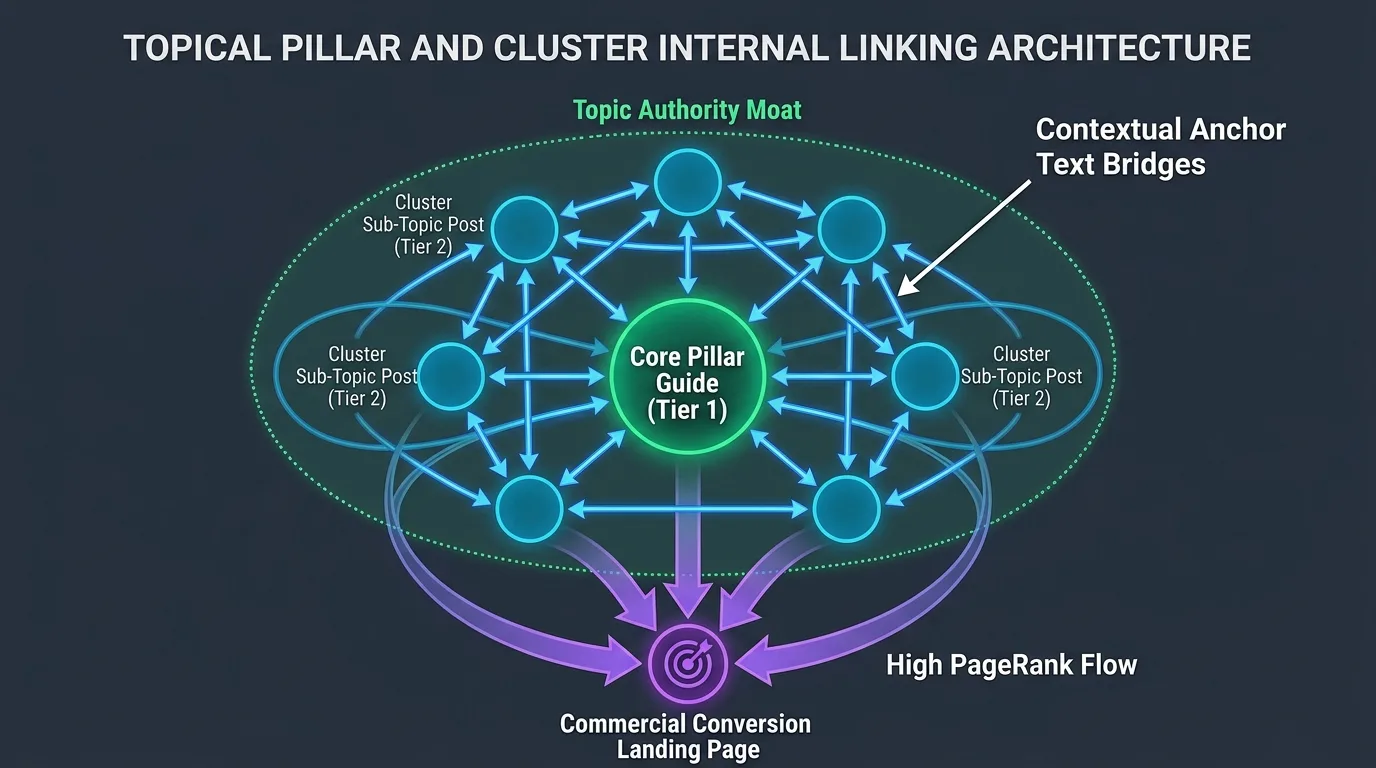
6. The Content Decay Curve in the AI Era: Why Commodity Guides Decay 3x Faster
In traditional search environments, an evergreen guide might retain organic rankings for 2 to 3 years with minimal maintenance. In the modern AI-saturated ecosystem, commodity articles suffer from rapid organic traffic decay within 6 to 9 months of publication.
This acceleration is driven by two algorithmic dynamics:
- Synthetic Dilution: As competitors deploy autonomous AI writing bots targeting identical keywords, Google's index is flooded with thousands of semantically equivalent pages. Google's core updates periodically cull pages that fail to exhibit unique user engagement signals or novel vectors.
- Zero-Click Answer Cannibalization: When Google's AI Overviews successfully extract the consensus answer to an informational query, click-through rates to commodity positions drop by 40% to 65%. Only pages offering deep, proprietary case studies retain direct human visits.
The Evergreen Defensibility Playbook
To insulate your library against content decay, adopt a quarterly data refresh rhythm:
- Audit declining Search Console URLs where impressions remain steady but CTR has dropped, signaling AI Overview displacement.
- Inject newly calculated benchmark data, recent production incident telemetry, or updated API versions.
- Add interactive client-side calculator widgets or code sandboxes to create non-summarizable utility.
- Re-validate semantic novelty using our automated Information Gain auditor script before requesting re-indexing.
7. Structuring Proprietary Data Studies That Earn Tier-1 Backlinks
Conducting and publishing original benchmark research is the most cost-effective link acquisition and authority strategy in digital marketing. When you publish definitive statistics (e.g., "We analyzed 4.2 million faceted URLs and found that 68% create crawl budget waste"), industry authors naturally reference your findings when drafting their own guides.
The 5-Step Research Report Playbook
- Identify an Unanswered Industry Question: Avoid general surveys. Focus on specific, contentious operational debates (e.g., "Does optimizing INP below 150ms measurably increase checkout conversion rates?").
- Extract Verifiable Telemetry: Query your internal database, scrape public APIs ethically, or poll a verified cohort of at least 250 verified practitioner leads.
- Visualize Key Findings: Transform statistical distributions into branded, high-contrast 16:9 charts with clear source watermarks.
- Publish an Executive Summary Card: Place key takeaways, sample sizes, and methodology notes at the very top of the page for rapid journalist citation.
- Seed with Industry Influencers: Share preliminary data with prominent podcasters and newsletter editors 48 hours prior to public launch under embargo.
For technical teams engineering scalable crawling frameworks to monitor competitor data studies, consult our guide on building a custom multi-threaded web scraper with Python and Playwright.
8. Editorial Performance Benchmarks: Measuring Content Defensibility
Table 2 provides the primary metrics required to evaluate whether your editorial engine is generating true information gain and domain authority:
| Defensibility Metric | Data Source | Diagnostic Significance | Healthy Growth Target |
|---|---|---|---|
| Organic Backlink Velocity | Google Search Console & Ahrefs | Natural links earned without outreach indicates high utility | > 5 new referring domains per month per pillar post |
| Average Dwell Time | GA4 User Engagement Reports | Verifies readers actually consume long-form technical insights | > 3 minutes and 45 seconds on desktop |
| Scroll Depth 75%+ Rate | Custom Tag Manager Scroll Triggers | Confirms readers engage with prescriptive solutions and CTAs | > 42% completion rate |
| AI Overview Citation Frequency | Rank Tracking Telemetry | Direct confirmation of high semantic Information Gain scores | Cited in > 50% of related generative queries |
| Direct Brand Search Growth | Search Console Query Reports | Demonstrates that readers seek out your publication by brand name | > 25% year-over-year expansion in brand queries |
9. The 7-Step Editorial Quality Gate Checklist
Enforce this pre-publication checklist across your content marketing organization before scheduling any new pillar post:
- Verify Proprietary Data Inclusions: Does the article feature at least one exclusive data point, benchmark metric, or case study from first-party telemetry?
- Eliminate Obvious Definitions: Are opening sentences free of dictionary definitions and generic platitudes?
- Inspect Visual Uniqueness: Are all technical diagrams custom-designed with zero reliance on generic stock photo libraries?
- Validate Practitioner Code Snippets: Have all scripts, SQL queries, or configuration blocks been tested in an active runtime environment?
- Audit Contextual Internal Linking: Are there at least 4 in-body hyperlinks pointing to relevant topic cluster companion articles using natural, descriptive anchors?
- Test Interactive Elements: Do FAQ accordions, calculators, and data tables render cleanly across mobile and desktop viewports with zero layout shift?
- Confirm E-E-A-T Author Attribution: Is the article linked to a verified author profile with demonstrated expertise in the subject domain?
10. Frequently Asked Questions (FAQ)
What is Google's Information Gain score in SEO?
Information Gain is a patented ranking mechanism used by Google to evaluate how much unique, novel information a web document provides to a user relative to other documents they have already viewed. Pages that simply regurgitate existing top-ranking content receive low Information Gain scores and are progressively de-prioritized.
Why is the traditional Skyscraper Technique failing in 2026?
The Skyscraper Technique relied on aggregating existing ideas into longer articles. Because AI models can synthesize commodity information instantly, search engines and human readers now penalize unnecessary word count and demand original data, novel angles, and real-world practitioner proof.
How can smaller websites with low domain authority compete on Information Gain?
Smaller sites can outrank legacy media by publishing niche, hyper-specific proprietary research, real client case studies, and transparent teardowns that large corporate brands are unwilling or unable to publish. Google's algorithms reward genuine first-hand expertise regardless of domain size.
What qualifies as "first-hand experience" under Google's E-E-A-T guidelines?
First-hand experience includes documented evidence that the author personally tested software, managed production systems, gathered field data, or solved real business problems. Examples include terminal logs, unique screenshots, custom benchmark data, and detailed post-mortem reviews.
Can AI writing tools be used while still maintaining high Information Gain?
Yes, if AI is utilized for formatting, outlining, or code linting while the core data, opinions, case studies, and strategic insights are supplied directly by experienced human practitioners. Using AI to generate unsupervised end-to-end articles almost always results in zero Information Gain.
How do interactive embeds improve content defensibility?
Interactive tools (such as cost calculators, schema generators, and audit forms) provide computational utility that cannot be summarized in a static text snippet. They drastically increase page dwell time, drive repeat visits, and earn editorial backlinks from industry resource hubs.
What is the best format for publishing original data studies?
Structure data studies with a high-level executive summary, key statistical takeaways, branded data charts, a transparent methodology section, and downloadable raw datasets (such as CSVs). This format provides journalists and researchers with everything needed to cite your work.
How does Information Gain impact inclusion in Google AI Overviews?
Google's Gemini models prioritize documents with high Information Gain when selecting sources for AI Overviews. Articles that supply novel data vectors or unique factual triples are chosen as primary citation cards, while redundant pages are omitted.
How many original data studies should a content team publish each year?
Most high-growth B2B publications find success publishing 2 to 4 authoritative proprietary benchmark studies per year. These flagship reports can then be repurposed into dozens of cluster articles, social threads, and newsletter editions over a twelve-month cycle.
What is the risk of publishing unverified or fabricated data in SEO content?
Publishing false or unverified statistics destroys brand trust, risks public reputational damage, and violates Google's factual accuracy guidelines. Machine learning models reconcile claims against the Knowledge Graph, and pages with conflicting factual triples face harsh algorithmic demotion.



Ratings & reviews
No reviews yet. Be the first.