

Product detail pages (PDPs) represent the core revenue engine of enterprise e-commerce platforms. Yet, across millions of online retail catalogs, product pages suffer from systemic architectural flaws: manufacturer-copied boilerplate copy, unindexed client-side rendered specifications, bloated imagery that destroys Core Web Vitals, and catastrophic out-of-stock handling that squanders valuable backlink equity. In 2026's search landscape, where Google Merchant Center feeds, Shopping Graph algorithms, and multi-modal AI visual agents power organic product discovery, mastering product page SEO architecture is mandatory for e-commerce survival.

1. The Anatomy of an Enterprise Product Detail Page (PDP)
Modern e-commerce search engine optimization transcends basic keyword placement. An enterprise product page is an intricate data composite that must simultaneously satisfy three demanding stakeholders: human shoppers demanding frictionless purchasing, search engine crawlers demanding clean machine-readable markup, and automated AI shopping agents extracting structured pricing and inventory specifications.
Every high-performing product page rests upon four structural pillars:
- Server-Rendered Semantic Core: Primary product titles (H1), canonical descriptions, brand attributes, SKU/GTIN identifiers, and base pricing must reside in the raw server-rendered HTML response, avoiding reliance on fragile client-side hydration as detailed in our guide on server-side rendering (SSR) vs static site generation (SSG).
- Structured Attribute & Specification Tables: Clean, semantic HTML
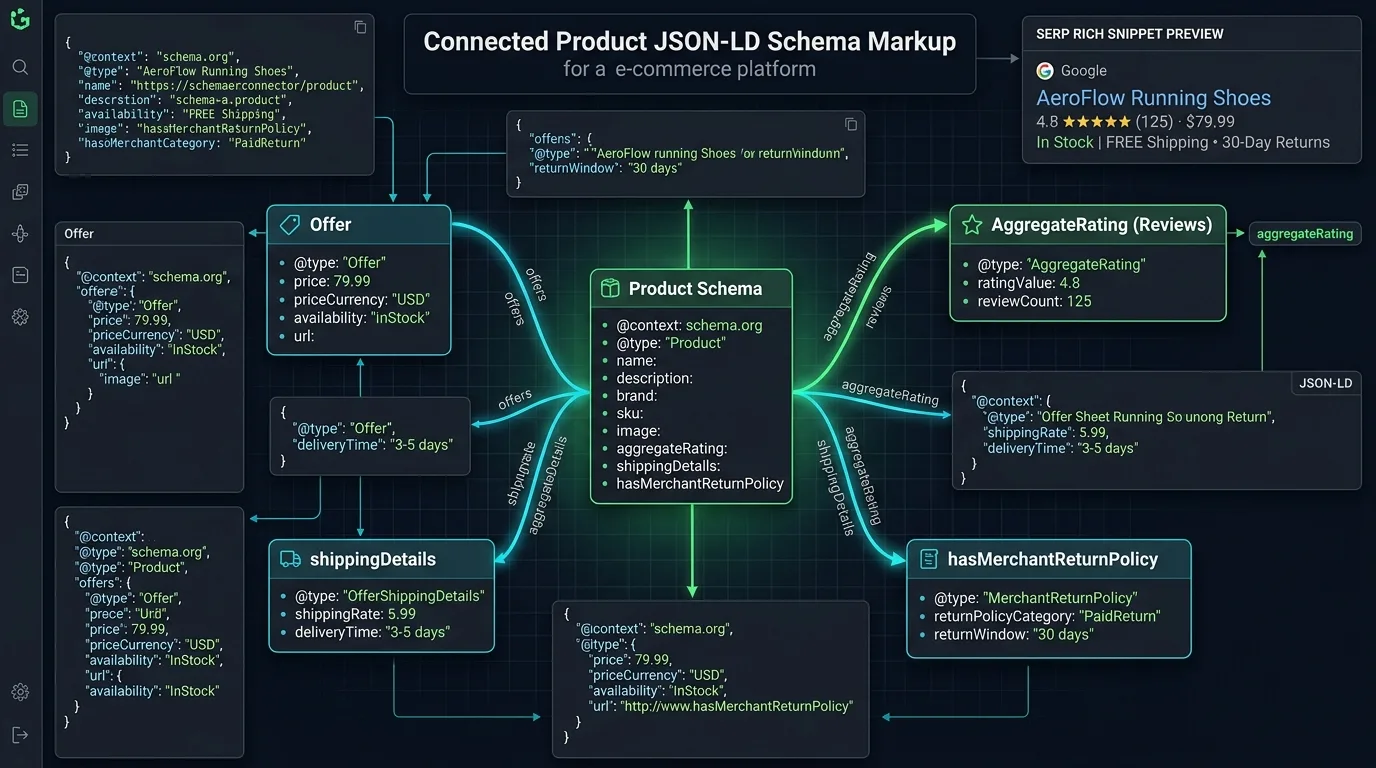
<table>elements presenting dimensions, materials, technical compatibilities, and certifications. - Connected Product Schema Graphs: Nested JSON-LD markup uniting
Product,Offer,MerchantReturnPolicy, andShippingDetailsinto an unbroken entity cluster. - Responsive, Highly Optimized Media Pipelines: WebP/AVIF imagery with explicit dimensions, responsive srcset attributes, and interactive 3D/video embeds loaded without layout shifts.
2. The High-Converting Product Copy Formula: Eliminating Manufacturer Boilerplate
The single most pervasive failure in e-commerce SEO is copying verbatim product descriptions provided by manufacturers. When three hundred independent retailers paste the identical distributor copy onto their pages, Google's deduplication filters identify the earliest-indexed domain or the highest-authority marketplace (such as Amazon), classifying all other instances as duplicate syndicated text.
To establish unmistakable uniqueness and Information Gain, deploy a structured copywriting blueprint:
| Content Component | Recommended Word Count | Primary Search Purpose | Conversion Impact |
|---|---|---|---|
| Above-the-Fold Elevator Hook | 40–60 Words | Defines primary problem-solution fit & core value prop | Immediate bounce reduction |
| Proprietary In-Depth Overview | 180–300 Words | Targeted long-tail semantic keyword & entity integration | High informational & commercial intent capture |
| Key Benefits & Use-Cases Bulleting | 100–150 Words | Scannability for mobile shoppers; featured snippet targeting | Accelerates evaluation velocity |
| Technical Specifications Table | Comprehensive Table | Extractable structured data for Google Shopping Graph | High comparison confidence |
| Customer QA & Verified Reviews | User-Generated | Freshness signals, long-tail query diversity, and social proof | Direct checkout conversion lift |
3. Technical Specification Tables: Structuring the Attribute Mesh
Technical specifications are not merely informative for consumers; they are primary feeding grounds for Google's Shopping Graph. When searchers query ultra-specific attribute filters (e.g., "stainless steel 316 dual-voltage submersible pump 1.5 HP"), algorithms scan tabular attribute matrices to identify matching items.
When engineering specification modules, avoid rendering attributes inside nested accordion tabs that rely entirely on JavaScript click events to inject content into the DOM. Render the complete table directly into the static HTML with clean <th> and <td> pairs, utilizing CSS to manage viewport responsiveness.
4. Managing Product Variants Without Keyword Cannibalization
E-commerce catalogs featuring products with multiple variants (colors, sizes, storage capacities, finishes) face a perpetual architectural dilemma: should each variant have a distinct indexable URL, or should all variants consolidate into a single parent URL?
Follow the Search Volume & Intent Rule:
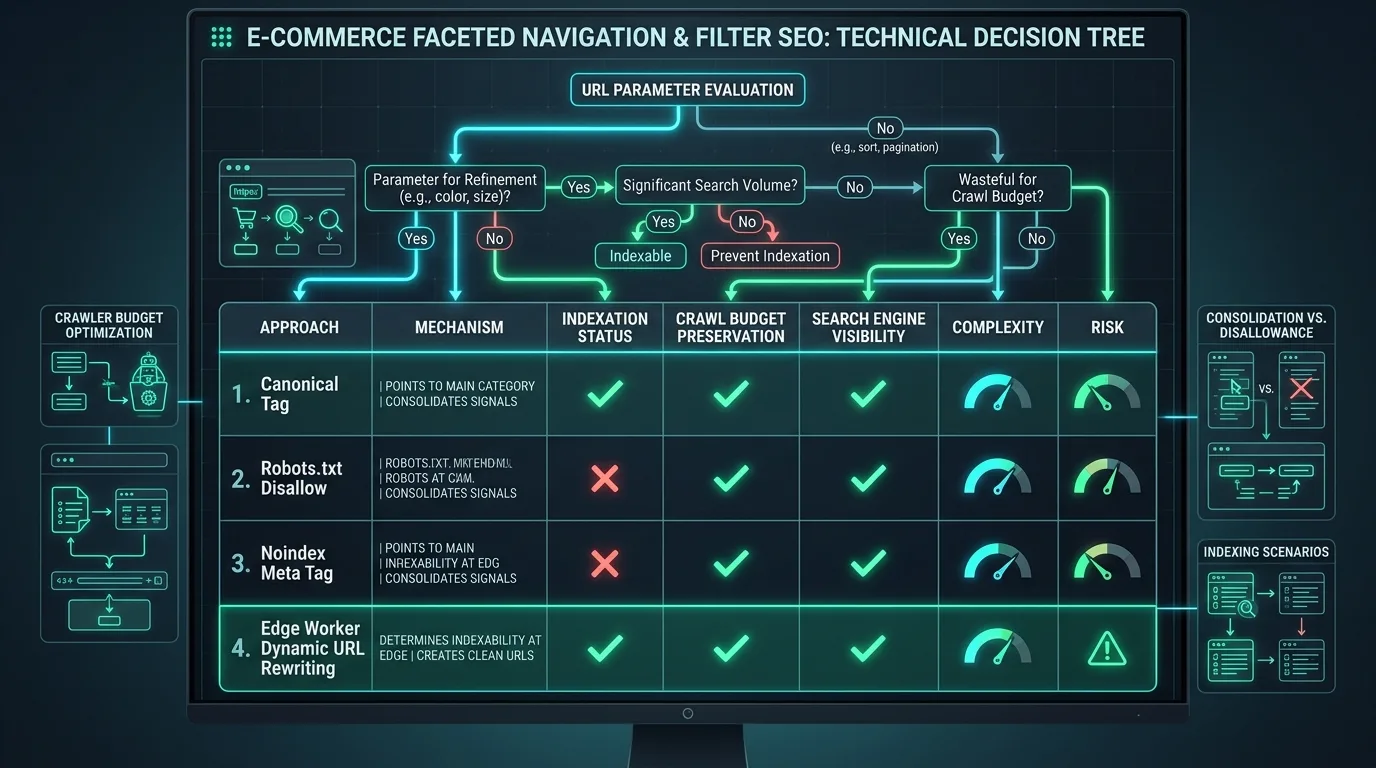
- Consolidate into Single URL (Default Best Practice): If variations have negligible standalone search demand (e.g., a t-shirt available in Small, Medium, Large, or XL), maintain one canonical URL. Use JavaScript or URL parameters (e.g.,
?size=xl) with a self-referencing canonical tag pointing back to the clean parent URL:/products/organic-cotton-crewneck. - Dedicated Independent URLs (High-Intent Attributes): If specific variants command substantial distinct search volume (e.g., "iPhone 16 Pro 256GB Desert Titanium" vs "iPhone 16 Pro 1TB Black"), assign unique indexable URLs with dedicated titles, custom schema, and distinct image galleries.
Canonical Variant Architecture Blueprint
When operating with consolidated variant URLs, deploy canonical tags that programmatically resolve parameter variations back to the clean parent resource:
<!-- Clean Canonical Tag on Parameterized Variant Pages -->
<link rel="canonical" href="https://seobeen.com/products/organic-cotton-crewneck" />

<!-- Variant Schema Representation using AggregateOffer -->
<script type="application/ld+json">
{
  "@context": "https://schema.org",
  "@type": "Product",
  "name": "Organic Cotton Crewneck",
  "offers": {
    "@type": "AggregateOffer",
    "priceCurrency": "USD",
    "lowPrice": "34.00",
    "highPrice": "42.00",
    "offerCount": "4"
  }
}
</script>
Failing to canonicalize variant parameters results in massive URL inflation and crawl budget depletion, as analyzed in our deep dive on faceted navigation and URL bloat mitigation.
5. The Out-of-Stock Dilemma: Preserving Link Equity and User Trust
Handling inventory fluctuations is one of the most critical operational disciplines in e-commerce SEO. Deleting product pages the moment stock reaches zero, or redirecting expired URLs to the homepage, causes severe equity leaks and soft 404 penalties.
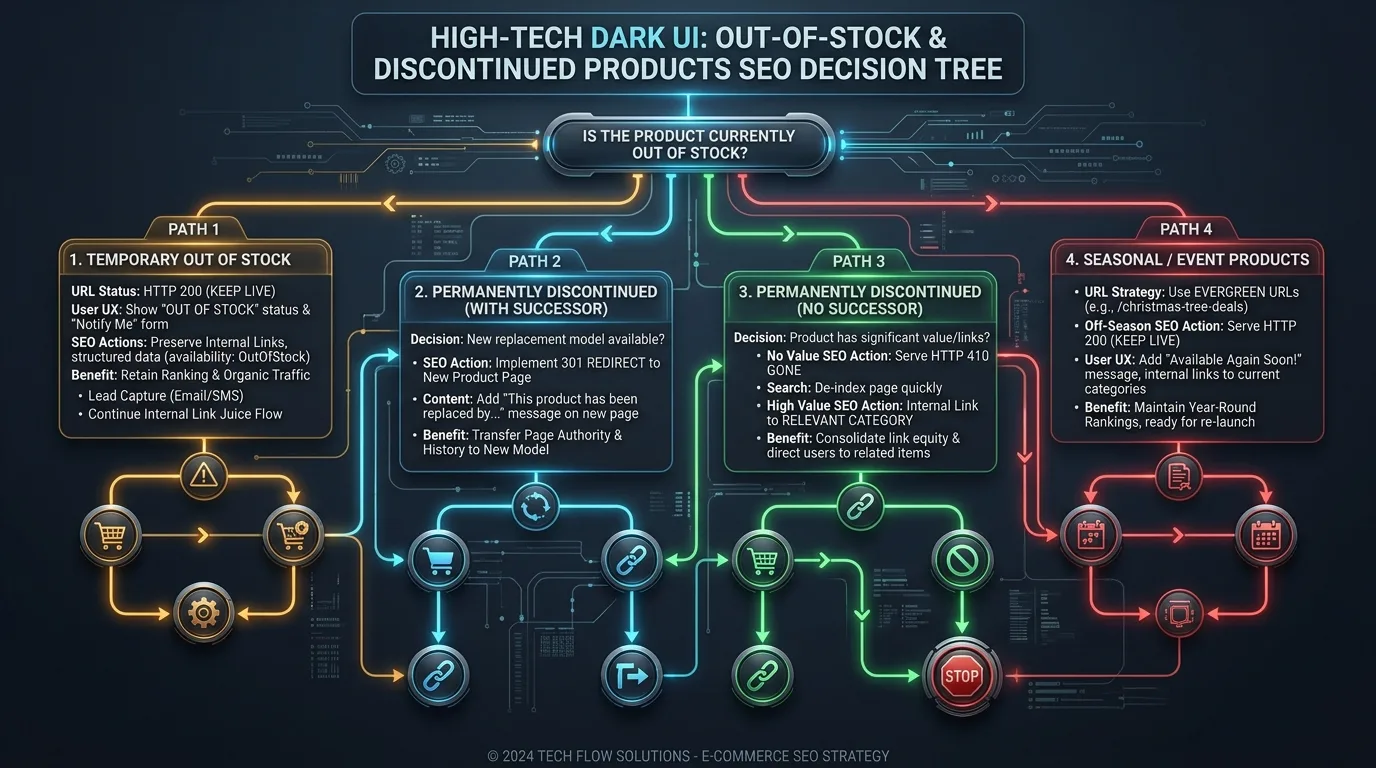
Deploy the appropriate protocol based on inventory permanence:
- Temporary Stockouts (Returning within 30–60 Days): Retain the 200 OK status code. Update the Schema
availabilityattribute tohttps://schema.org/OutOfStock. Display an email back-in-stock notification form and recommend relevant, in-stock related products to prevent bounce rates. - Permanent Discontinuation (Direct Equivalent Available): Implement an immediate
301 Moved Permanentlyredirect to the directly succeeding product model (e.g., Widget V1 redirects to Widget V2) to transfer accumulated backlink equity seamlessly. - Permanent Discontinuation (No Equivalent): If the item is permanently deleted with no direct substitute, either redirect to the parent category page or return a true
410 Gonestatus code, following our architectural guidelines on HTTP status codes and redirection best practices.
6. Core Web Vitals on Heavy E-Commerce Product Pages
Modern e-commerce product pages are notorious for performance bloat: heavy third-party review widgets, live chat daemons, recommendation carousels, and uncompressed high-resolution hero galleries destroy mobile performance.

To ensure passing Core Web Vitals across your product catalog:
- Preload Hero Media: Use
<link rel="preload" as="image" href="hero.webp" fetchpriority="high">to optimize Largest Contentful Paint (LCP). - Explicit Aspect Ratios: Define width and height attributes on all product image containers to achieve zero Cumulative Layout Shift (CLS).
- Defer Non-Critical Third Parties: Load customer review carousels, size recommendation widgets, and live chat scripts asynchronously after initial main-thread idle.
7. Rich Product Schema Implementation: The Complete Enterprise Code Blueprint
Deploying complete, error-free structured data transforms ordinary search listings into rich commercial snippets featuring price drops, stock status, ratings, and shipping speeds.
<script type="application/ld+json">
{
  "@context": "https://schema.org",
  "@type": "Product",
  "name": "Industrial High-Pressure Centrifugal Pump",
  "image": [
    "https://seobeen.com/images/products/pump-front.webp",
    "https://seobeen.com/images/products/pump-side.webp"
  ],
  "description": "Heavy-duty 3-phase industrial centrifugal pump engineered for chemical processing and commercial fluid transfer.",
  "sku": "PUMP-IND-750",
  "mpn": "984210",
  "gtin13": "0123456789012",
  "brand": {
    "@type": "Brand",
    "name": "Seobeen Heavy Industrial"
  },
  "offers": {
    "@type": "Offer",
    "url": "https://seobeen.com/products/industrial-centrifugal-pump",
    "priceCurrency": "USD",
    "price": "2499.00",
    "priceValidUntil": "2027-12-31",
    "itemCondition": "https://schema.org/NewCondition",
    "availability": "https://schema.org/InStock",
    "seller": {
      "@type": "Organization",
      "name": "Seobeen E-Commerce"
    },
    "shippingDetails": {
      "@type": "OfferShippingDetails",
      "shippingRate": {
        "@type": "MonetaryAmount",
        "value": "0.00",
        "currency": "USD"
      },
      "shippingDestination": {
        "@type": "DefinedRegion",
        "addressCountry": "US"
      },
      "deliveryTime": {
        "@type": "ShippingDeliveryTime",
        "handlingTime": {
          "@type": "QuantitativeValue",
          "minValue": 0,
          "maxValue": 1,
          "unitCode": "d"
        },
        "transitTime": {
          "@type": "QuantitativeValue",
          "minValue": 2,
          "maxValue": 5,
          "unitCode": "d"
        }
      }
    },
    "hasMerchantReturnPolicy": {
      "@type": "MerchantReturnPolicy",
      "applicableCountry": "US",
      "returnPolicyCategory": "https://schema.org/MerchantReturnFiniteReturnWindow",
      "merchantReturnDays": 30,
      "returnMethod": "https://schema.org/ReturnByMail",
      "returnFees": "https://schema.org/FreeReturn"
    }
  },
  "aggregateRating": {
    "@type": "AggregateRating",
    "ratingValue": "4.9",
    "reviewCount": "87"
  }
}
</script>
8. Internal Linking to and from Product Pages
Product pages must not exist as isolated dead-ends at the bottom of your site architecture. Strategic internal linking passes link equity bidirectionally across your catalog:
- Dynamic Category Breadcrumbs: Implement semantic breadcrumb navigation using
BreadcrumbListschema to connect products back to sub-categories and primary category hubs. - Topical Cross-Sells & Complementary Bundles: Contextually link related accessories and compatible components (e.g., linking a camera body to specific compatible lenses).
- Reverse Editorial Links: Hyperlink directly from high-authority informational buying guides and comparative reviews directly into commercial product checkout pages using descriptive keyword anchor text.
Adhering to our proven principles in search intent optimization ensures that users transitioning from educational guides to product checkout experience zero cognitive friction.
9. Image SEO and Multi-Modal AI Shopping Search
With the rise of Google Lens, visual search, and AI-assisted shopping discovery, optimizing visual assets on product pages is no longer optional. Image optimization requires:
- Descriptive Filenames: Replace generic camera names like
IMG_8492.jpgwith keyword-rich semantic filenames:industrial-centrifugal-pump-side-view.webp. - Contextual Alt Text: Provide detailed, functional alt descriptions that articulate color, angle, and specific hardware attributes for screen readers and visual AI models.
- Image XML Sitemaps: Include all high-resolution product media within dedicated image sitemaps, specifying image titles, geolocation, and licensing tags.
Responsive Modern Picture Tag Architecture
To deliver next-generation image formats without sacrificing backward compatibility or Core Web Vitals, implement responsive <picture> tags:
<picture>
  <source type="image/avif" srcset="/images/products/pump-1200.avif 1200w, /images/products/pump-800.avif 800w" sizes="(max-width: 768px) 100vw, 50vw" />
  <source type="image/webp" srcset="/images/products/pump-1200.webp 1200w, /images/products/pump-800.webp 800w" sizes="(max-width: 768px) 100vw, 50vw" />
  <img src="/images/products/pump-800.jpg" alt="Industrial high-pressure centrifugal pump side view showing 3-phase motor casing" width="800" height="600" loading="lazy" />
</picture>
This implementation guarantees that search engine visual crawlers receive optimal image compression while preserving exact aspect ratios to eliminate layout shifts.
10. The E-Commerce Product Page SEO Audit Checklist
To guarantee that your product catalog dominates both traditional search and AI shopping engines, execute this comprehensive audit checklist quarterly:
| Audit Dimension | Target Standard | Validation Protocol | Remediation Action |
|---|---|---|---|
| Structured Data | 0 Schema Errors / Warnings | Google Rich Results Test | Validate Product, Offer, Shipping, and Return JSON-LD markup. |
| Canonical Tags | Unambiguous Self-Referencing | Screaming Frog Crawl | Ensure variant parameter URLs point back to clean master URL. |
| Stock Status Sync | Real-time GSC & GMC parity | Google Merchant Center Diagnostics | Automate schema availability updates when inventory reaches zero. |
| Description Originality | > 85% Copyscape Uniqueness | Automated Plagiarism Auditing | Rewrite manufacturer boilerplate; add original user-case benefits. |
| Mobile CWV Health | LCP < 2.2s, CLS < 0.05 | PageSpeed Insights Field Data | Preload hero WebP media; defer reviews and live chat widgets. |
Frequently Asked Questions About Product Page SEO
How do I optimize product pages for Google Shopping Graph?
To optimize for Google's Shopping Graph, embed comprehensive Product JSON-LD schema containing GTIN/MPN identifiers, exact brand details, structured technical attributes, real-time pricing and stock status, merchant return policies, and transparent shipping rates.
Should product variants have separate URLs or one single URL?
If product variations (such as small vs large) have minimal standalone search volume, consolidate them onto a single canonical URL. If specific variants command significant search demand (such as unique model numbers or distinct colors), assign dedicated URLs with self-referencing canonicals.
What is the best way to handle temporarily out-of-stock products?
Keep the page live with a 200 OK status code. Update the Product schema availability to OutOfStock, display an email back-in-stock notification form, and present related in-stock alternatives to preserve user dwell time and ranking equity.
Why is manufacturer-supplied product copy harmful to SEO?
Manufacturer descriptions are syndicated across hundreds of competing websites. Google's deduplication algorithms filter out identical copy, favoring high-authority platforms like Amazon while treating smaller retail sites as redundant duplicate content.
What GTIN and MPN attributes should be included in product schema?
Include global trade identification numbers such as GTIN-8, GTIN-12 (UPC), GTIN-13 (EAN), or GTIN-14, along with the Manufacturer Part Number (MPN). These unique identifiers allow Google to match your listing directly to exact product entities in its Shopping Graph.
How does page speed impact e-commerce product page rankings and revenue?
Page speed is both a direct Google ranking factor and a critical conversion driver. Studies indicate that every 100ms reduction in page load latency improves retail conversion rates by up to 8% and significantly reduces cart abandonment.
How should I handle permanently discontinued products with backlinks?
Implement a 301 redirect pointing to the closest direct replacement model or modern successor. If no direct replacement exists, redirect to the relevant sub-category page to preserve accumulated link equity.
What role do customer reviews play in product page SEO?
Customer reviews provide continuous content freshness, introduce natural long-tail keyword variations, and qualify the page for star-rating rich snippets in search results via AggregateRating schema markup.
How do I optimize product images for visual search engines like Google Lens?
Use high-resolution, uncompressed WebP images shot from multiple angles against clean backgrounds. Ensure descriptive, hyphenated file names, comprehensive alt text, and inclusion in structured image sitemaps.
How can I prevent duplicate content caused by tracking parameters on product pages?
Configure self-referencing canonical tags on all base product URLs, utilize URL parameter handling rules in Google Search Console, and set up edge rewrite rules to strip tracking queries before indexing.



Ratings & reviews
No reviews yet. Be the first.