

HTTP status codes are the fundamental protocol language through which web servers communicate the state, location, and cacheability of digital assets to search engine web crawlers. Misinterpreting the architectural difference between a 301 and 302 redirect, deploying 307 temporary redirects during permanent site migrations, or returning soft 200 OK headers on deleted pages causes catastrophic PageRank equity leaks, crawl budget exhaustion, and sudden index de-ranking. Master the complete technical taxonomy of HTTP response headers, redirection chains, and status code best practices engineered for modern search architectures.

1. The Foundation of HTTP Protocols: How Search Engines Interpret Server Status Responses
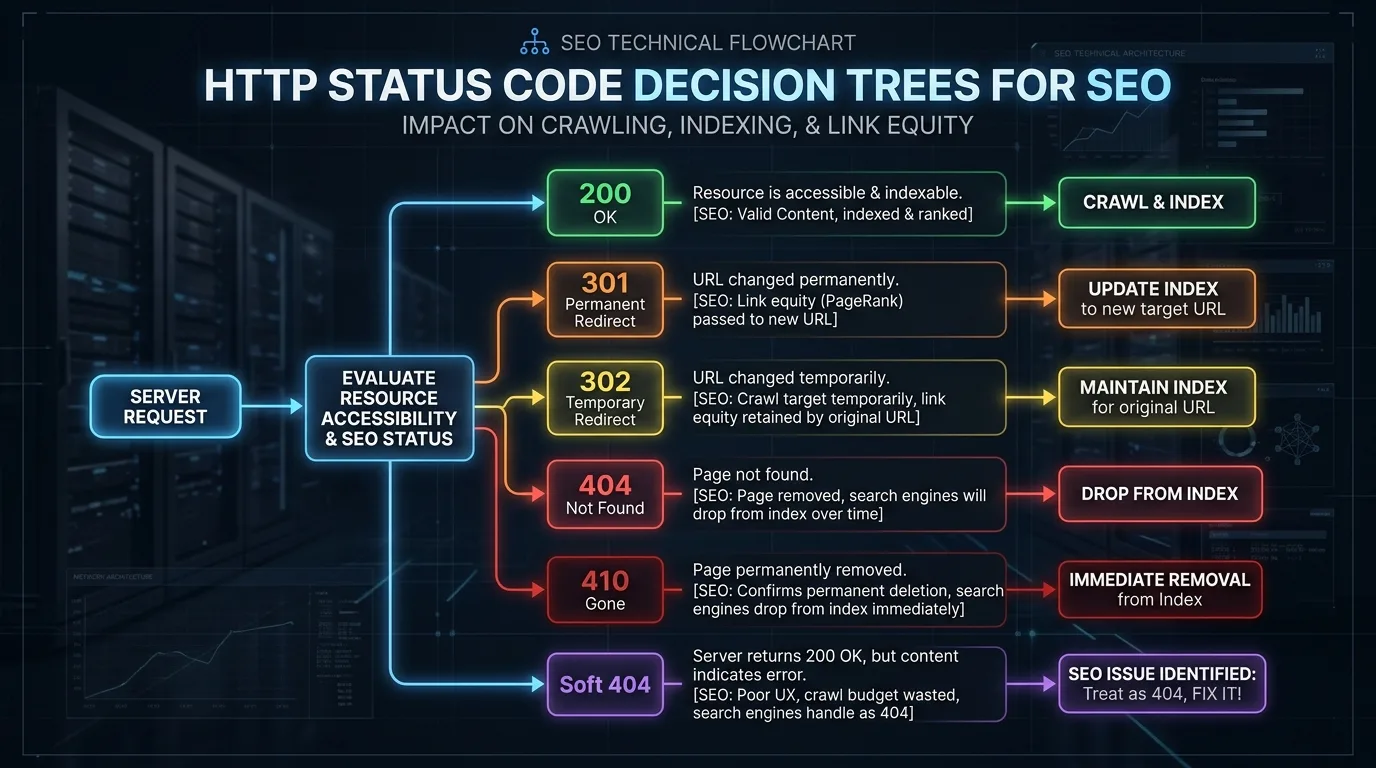
Every interaction between Googlebot and your web server begins with an HTTP GET or HEAD request. Before an engine can parse HTML tokens, construct Document Object Models (DOMs), execute JavaScript bundles, or calculate CSS styles, it evaluates the three-digit numeric response header transmitted by the origin or edge proxy. This status code dictates whether the resource will be cached, rendered, followed, or permanently expunged from the search index.
Hypertext Transfer Protocol status codes are grouped into five standardized classes defined by the Internet Engineering Task Force (IETF):
- 1xx (Informational): Request received, protocol handshake continuing (e.g., 100 Continue, 101 Switching Protocols). Inconsequential for organic indexing.
- 2xx (Success): The action was successfully received, understood, and accepted. For search crawlers, a
200 OKis the mandatory prerequisite for indexing evaluation. - 3xx (Redirection): Further action must be taken by the user agent to complete the request. The canonical backbone of site migrations, URL restructuring, and PageRank routing.
- 4xx (Client Errors): The request contains bad syntax, unauthorized access, or points to resources that no longer exist on the server (e.g., 404 Not Found, 410 Gone).
- 5xx (Server Errors): The server failed to fulfill an apparently valid request due to origin timeouts, crashing daemon processes, or gateway misconfigurations (e.g., 500 Internal Server Error, 503 Service Unavailable).
In high-scale enterprise architectures, subtle HTTP header misalignments compound rapidly. As explored in our deep dive on the 80/20 rule of search engine optimization, resolving systemic status code errors and redirect chains sits firmly within the top 20% of high-leverage technical initiatives that protect sitewide organic revenue.
2. The Technical Redirection Taxonomy: 301 vs 302 vs 307 vs 308
While web browsers seamlessly navigate through redirections, search engine crawlers treat distinct 3xx response headers with starkly different algorithmic rules. The table below delineates the exact behavioral specifications of each primary redirection status code.
| Status Code | Standard Definition | HTTP Spec | Method Rewriting | PageRank Transfer | Canonical Indexation |
|---|---|---|---|---|---|
| 301 Moved Permanently | Resource has permanently relocated to target URI. | HTTP/1.0 & 1.1 | May change POST to GET | Full (100% Equity) | Index shifts permanently to destination URI. |
| 302 Found (Moved Temporarily) | Resource temporarily resides under different URI. | HTTP/1.0 & 1.1 | May change POST to GET | Deferred (Retained on Source) | Source URI remains indexed; destination is not canonized. |
| 307 Temporary Redirect | Temporary redirect preserving exact HTTP request method. | HTTP/1.1 | Guaranteed no method rewrite | Deferred (Retained on Source) | Source URI retained; intended for temporary maintenance. |
| 308 Permanent Redirect | Permanent redirect preserving exact HTTP request method. | HTTP/1.1 (RFC 7538) | Guaranteed no method rewrite | Full (100% Equity) | Destination URI canonized permanently. |
The 301 Moved Permanently Standard
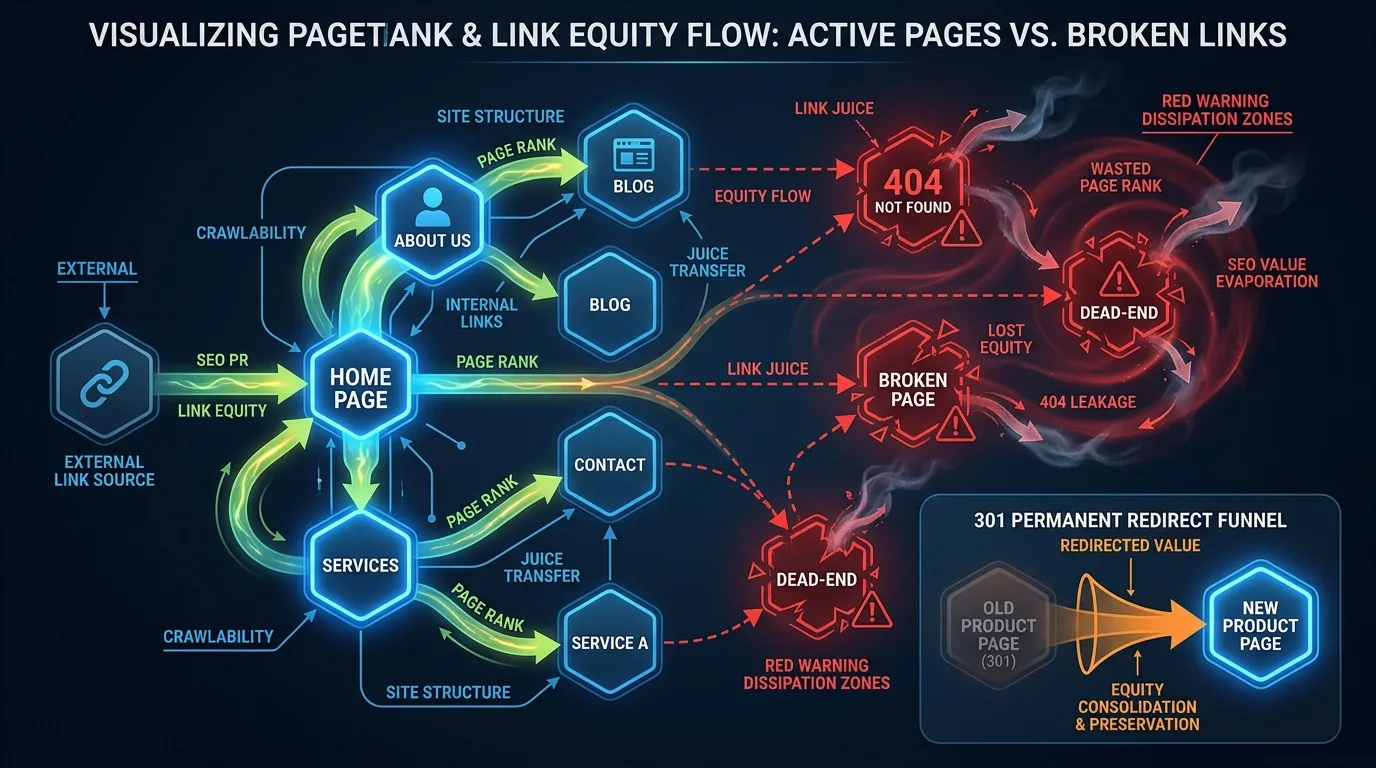
A 301 Moved Permanently response informs search spiders that all historical ranking signals, anchor text equity, and user signals associated with the origin URL must transfer completely to the new target URL. In Google's modern indexing pipeline, a 301 passes virtually 100% of PageRank equity without dilution. However, the canonical transition is not instantaneous: Googlebot must recrawl the legacy URL multiple times over several weeks to confirm the permanent state before updating the primary serving index.
The Danger of Inadvertent 302 and 307 Redirects
When engineering teams execute site migrations or URL rewrites using default web framework utilities (such as Express.js res.redirect() or Next.js middleware without explicit status overrides), servers default to 302 Found or 307 Temporary Redirect. Because temporary redirects explicitly instruct search engines to retain the original URL in the index, Google continues serving the old URL while splitting indexing signals, resulting in ranking stagnation and split impressions.
The Modern 308 Permanent Redirect
Introduced in RFC 7538, the 308 Permanent Redirect is the permanent equivalent of the 307. Unlike a 301, which historically permitted user agents to alter an HTTP POST request into a GET request, a 308 strictly forbids method mutation. Modern enterprise APIs and headless single-page applications operating on HTTP/2 and HTTP/3 should leverage 308 status codes for RESTful endpoints and transactional forms where request body integrity must be preserved.
3. Redirect Chains, Redirect Loops, and Equity Dissipation
One of the most insidious technical debts encountered on mature enterprise domains is the accumulation of redirect chains. A redirect chain occurs when URL A redirects to URL B, which subsequently redirects to URL C, before finally resolving at URL D (e.g., A -> B -> C -> D).
Redirect chains damage search performance through three distinct mechanisms:
- Latency and Time to First Byte (TTFB): Every intermediate hop requires a complete round-trip DNS resolution, TLS handshake, and TCP socket negotiation. A three-hop chain can introduce 600ms to 1,200ms of avoidable latency, severely harming Core Web Vitals and user conversion velocity.
- Crawler Abandonment: Googlebot will follow a maximum of five consecutive redirect hops in a single crawl attempt before terminating the request. If an edge proxy adds an additional protocol or trailing-slash redirect, the crawler aborts, treating the asset as unreachable.
- Equity Dissipation: While Google confirms that individual 301s pass full equity, complex multi-hop chains spanning multiple years and protocols introduce canonical ambiguity, increasing the probability that Google assigns canonical status to an intermediate URL or drops the page from primary clusters.
4. The 404 Not Found vs 410 Gone Dilemma: Rapid Index De-Listing
When URLs are permanently discontinued, e-commerce products sold out, or thin content pruned, webmasters must decide between serving an HTTP 404 Not Found or an explicit 410 Gone.
Although both status codes indicate that the requested resource does not exist, search engine crawler scheduling differs significantly:
- HTTP 404 (Not Found): Googlebot treats a 404 as an ambiguous event. The crawler assumes the URL may have disappeared temporarily due to a CMS glitch, broken deployment, or server misconfiguration. Consequently, Googlebot retains the URL in its crawl queue, returning repeatedly over days or weeks to verify whether the resource reappears before finally removing it from the index.
- HTTP 410 (Gone): A 410 is an explicit, authoritative declaration that the resource was intentionally expunged and will never return. Googlebot processes 410 headers aggressively: the URL is immediately removed from the active serving index and its crawl frequency drops exponentially.
For high-volume content pruning exercises—such as purging thousands of legacy thin articles to comply with the Google Helpful Content System—returning true 410 Gone headers accelerates domain rehabilitation by weeks compared to generic 404 responses.
5. Soft 404 Errors: The Silent Killer of Organic Crawl Budgets
A "Soft 404" is an architectural anti-pattern where a server returns a successful 200 OK response header while presenting an HTML page that visually informs the user the page does not exist (e.g., displaying "Sorry, page not found" or redirecting to an empty homepage).
Soft 404s inflict massive damage on technical SEO health:
- Crawl Budget Waste: Googlebot allocates significant rendering and extraction resources to analyze content that has no value, consuming crawler bandwidth that should be directed toward high-value commercial landing pages.
- Algorithmic Quality Depletion: When Google's automated classifiers detect hundreds of identical error templates returning 200 OK headers, the domain's sitewide content quality profile is downgraded.
- Duplicate Content Cannibalization: When hundreds of non-existent URLs serve the identical default fallback HTML page, search engines attempt to cluster and rank the empty placeholder against legitimate keywords.
To audit and remediate soft 404 anomalies across your domain, export your Coverage report data and analyze response patterns programmatically, as demonstrated in our tutorial on automating Google Search Console data exports with Python.
6. Server Errors (5xx) and Infrastructure Resilience: Impact on Indexing
When an origin server encounters unhandled exceptions, database connection timeouts, or proxy failures, it transmits 5xx status codes (500, 502, 503, 504). While a single isolated 500 error will not destroy rankings, sustained server errors trigger immediate algorithmic de-indexing.
The 503 Service Unavailable Exception
When performing scheduled maintenance, deploying major database migrations, or mitigating DDoS traffic, never allow your web server to return 500 Internal Server Error or 502 Bad Gateway. Instead, configure your edge proxy (Cloudflare, Fastly, or NGINX) to return an explicit 503 Service Unavailable accompanied by a Retry-After header:
HTTP/1.1 503 Service Unavailable
Content-Type: text/html; charset=UTF-8
Retry-After: 7200
Connection: close
The Retry-After: 7200 header informs Googlebot that the server is temporarily undergoing maintenance and requests that crawlers suspend scraping and return in exactly two hours. When Googlebot encounters a valid 503 with a Retry-After specification, it pauses crawling without penalizing existing indexation, ensuring zero ranking fallout during infrastructure updates.
7. Log File Telemetry: Auditing Real-Time Googlebot Response Codes
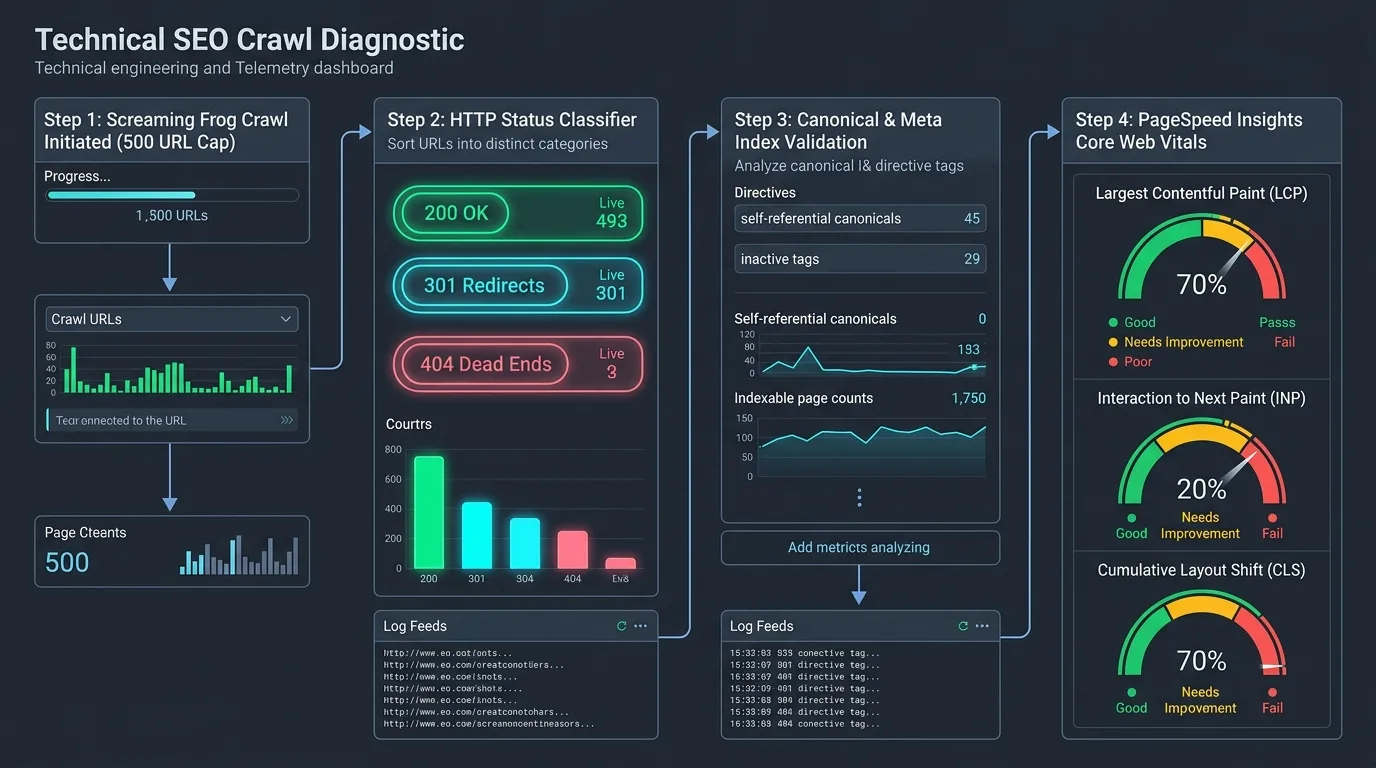
Third-party crawler audits (such as Screaming Frog or Sitebulb) simulate search engine visits, but they cannot reveal what Googlebot actually experiences in real-time. The definitive ground truth of status code health resides exclusively within your origin server access logs (NGINX, Apache, or CDN access logs).
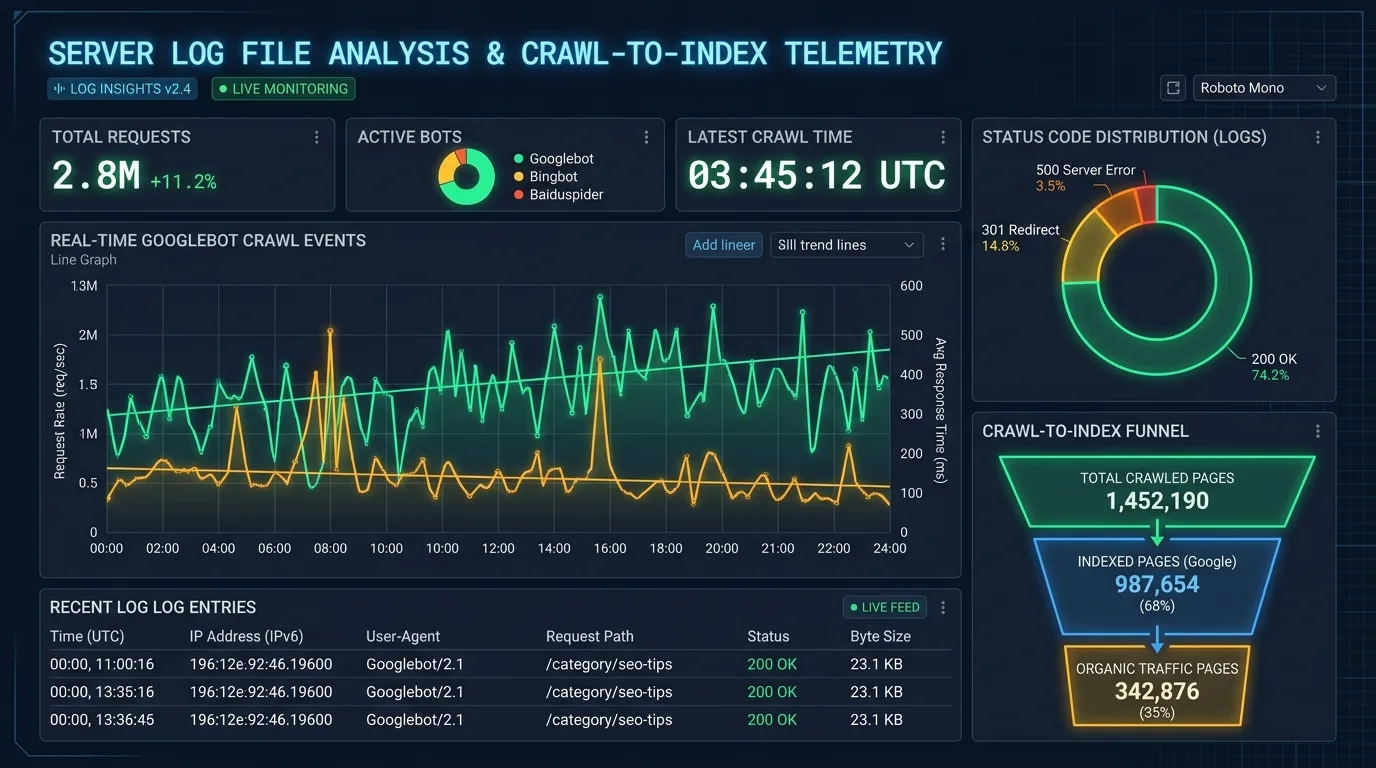
By parsing log files using shell utilities or custom Python pipelines, technical SEOs can construct response code distribution funnels. A healthy enterprise architecture should maintain a status profile where:
- 200 OK: Exceeds 92% of total search engine requests.
- 301 / 308: Remains under 5% of total requests (internal links must point directly to destinations).
- 404 / 410: Remains under 2% of total requests.
- 5xx Server Errors: Strict 0.0% threshold (any spike warrants an immediate DevOps escalation).
For dynamic e-commerce platforms with complex faceted navigation systems, real-time log monitoring prevents infinite crawl traps, as documented in our masterclass on faceted navigation SEO and crawl preservation.
8. Edge-Level Redirection Management: Cloudflare Workers and Fastly VCL
Managing tens of thousands of URL redirects at the origin web server level (via Apache .htaccess or NGINX rewrite directives) introduces CPU overhead and deployment friction. Every HTTP request forces the origin web server to evaluate hundreds of regex rewrite rules sequentially before rendering content.
Modern technical search engineering deploys redirects directly at the Content Delivery Network (CDN) edge utilizing serverless edge workers (Cloudflare Workers, Fastly VCL, or AWS CloudFront Functions). By storing redirect mapping tables in distributed edge key-value (KV) stores, redirects execute in less than 5 milliseconds globally, terminating the request before it touches your origin server.

9. The Master Audit Checklist: Remediating Status Code Anomalies
To maintain enterprise crawl efficiency, execute this structured audit checklist across your web infrastructure on a recurring monthly cycle:
| Audit Checkpoint | Target Specification | Detection Method | Remediation Protocol |
|---|---|---|---|
| Internal Redirection Hops | 0 Hops (Direct 200 OK) | Screaming Frog Inlinks Crawl | Update CMS internal links to target final destination URLs directly. |
| Protocol & Trailing Slash | 1 Single Hop at Edge | cURL -IL command | Combine HTTP-to-HTTPS and non-www-to-www into single edge rule. |
| Soft 404 Detection | 0 Soft 404 Instances | GSC Page Indexing Report | Configure server to transmit true 404 or 410 headers on empty templates. |
| Orphan 404 Backlink Leaks | 0 Broken High-Equity URLs | Ahrefs/Semrush Broken Backlinks | Implement 301 redirects from dead URLs to closest topical equivalent. |
| Origin 500 Error Spikes | < 0.01% Error Rate | Server Access Logs / Datadog | Scale database connection pools and configure edge timeout failovers. |
10. The Future of HTTP: HTTP/3, QUIC, and Early Hints (103)
The evolution of web transport protocols continues to redefine technical performance. The adoption of HTTP/3—built on the UDP-based QUIC protocol—eliminates head-of-line blocking across mobile networks, allowing search engine crawlers to fetch concurrent resources without connection stalls.
Furthermore, deploying 103 Early Hints headers allows web servers to send preliminary link headers (such as critical CSS stylesheets, hero image preloads, and core JavaScript chunks) to user agents and crawlers while the origin server prepares the primary 200 OK document. Embracing these advanced HTTP innovations ensures your technical infrastructure maintains a decisive competitive advantage in modern search discovery.
Frequently Asked Questions About HTTP Status Codes in SEO
What is the difference between a 301 and a 302 redirect for SEO?
A 301 redirect indicates a permanent relocation, signaling to search engines that they must transfer all ranking signals, backlink equity, and canonical authority to the destination URL. A 302 indicates a temporary move; Google will follow the redirect but retain the original URL in the search index without transferring link equity.
Do 301 redirects pass 100% of PageRank equity?
Yes. Google representatives have repeatedly confirmed that 301 and 302 redirects pass PageRank without loss under modern algorithms. However, long redirect chains introduce canonical ambiguity and latency, which can degrade overall ranking performance.
When should I use a 410 Gone instead of a 404 Not Found?
Use an HTTP 410 Gone when you have intentionally and permanently deleted content (such as expired product pages, pruned low-quality articles, or obsolete landing pages) and want search engines to remove the URL from their index as rapidly as possible.
What causes a Soft 404 error in Google Search Console?
A Soft 404 occurs when a server returns an HTTP 200 OK status code for a page that Googlebot determines is missing, empty, or an error page. This commonly happens when single-page applications or CMS themes render "Page Not Found" visually without configuring the web server to send an actual 404 header.
How do 5xx server errors impact search rankings?
Persistent 5xx errors (such as 500 or 502) prevent search engine spiders from crawling and verifying your pages. If a page continuously returns server errors for more than a few days, Googlebot will gradually de-index the page to protect search users from broken landing experiences.
What is an HTTP 503 status code and how does it protect SEO during maintenance?
An HTTP 503 Service Unavailable header informs search engines that the server is temporarily down for maintenance. When paired with a Retry-After header specifying when to return, Googlebot will pause crawling without dropping your pages from the index.
Why are redirect chains harmful to organic performance?
Redirect chains force user agents through multiple sequential server requests, adding substantial latency (increasing TTFB), exhausting crawler budgets, and causing Googlebot to abort crawling if the chain exceeds five hops.
What is an HTTP 308 redirect and when should it be used?
An HTTP 308 is a permanent redirect defined in RFC 7538 that strictly guarantees the HTTP request method (such as POST) will not be rewritten to GET. It is ideal for modern APIs, transactional payment gateways, and headless frontends.
How can I audit HTTP response codes across millions of URLs?
Use server access log analysis tools to inspect exact Googlebot requests, combined with multi-threaded desktop crawlers (like Screaming Frog) and the Google Search Console URL Inspection API to identify status code discrepancies at enterprise scale.
Do internal redirects damage PageRank distribution?
Yes. Internal links that point to 301 redirects waste crawl budget and introduce unnecessary latency. All internal navigation menus, contextual hyperlinks, and canonical tags should always point directly to the final destination 200 OK URL.



Ratings & reviews
No reviews yet. Be the first.